Jazz has a long tradition of brilliant small bands, starting with groups like Louis Armstrong’s Hot Five and Hot Seven and extending as far as today’s brilliant Vijay Iyer Trio or the antic quartet Mostly Other People Do the Killing.
Jazz also has a proud tradition of large groups, from Jelly Roll Morton Red Hot Peppers to the plethora of brilliant “big bands” that dominated popular music in the ‘30s and ‘40s to…
Well, what about today? What we think of as the classic jazz “big band” isn’t a thriving form today. That kind of group – with four trumpets, three trombones, and five saxophones roaring contrapuntally atop a sleek, swinging rhythm section – reached its first golden era with Ellington, Goodman, Basie and so on, and there were still brilliant big bands through the ‘60s: Woody Herman, Stan Kenton, Thad Jones-Mel Lewis.
Today, however, what we think of as a “big band” is something different, something less formulaic, a format that is having a very wonderful 2013.
A New Kind of Orchestral Jazz
The classic big bands were marvelous, and they had more range than their greatest hits would indicate. Ellington, in particular, stretched the bounds of what the basic 17-piece big band could achieve. His various orchestral suites took advantage of interesting colors: flutes, clarinets, fiddle, muted brass.
But mostly, the big bands had a basic sound, a set of great moves that sustained artistry for decades but begged for expansion. And in recent years that expansion has surged with creativity. The tradition still informs these new bands, but 2013 has brought a wash of stunning new “orchestral jazz” that requires attention.
The discs that have knocked me out lately are marked by larger bands, unusual instrumentation, the inclusion of singing or recitation, and the incorporation of jazz’s post-bop freedoms in such a way that these bands seem unmoored and unbounded, able to reach for the sounds of classical music, rock or soul, soundtrack music – or just about anything else.
Click here to read about great records from John Hollenbeck, Marty Ehrlich, Wadada Leo Smith, and Joel Harrison. Amazing stuff! Big Is Beautiful: Large Bands, Worlds of Sound
Header Quote
"If you ain't got it in you, you can't blow it out."
— Louis Armstrong
Monday, November 18, 2013
Thursday, November 7, 2013
Robert Glasper Experiment: Black Radio 2
Last year, Robert Glasper won the “Best R&B Album” Grammy for Black Radio, a recording that blended his roots as a jazz pianist with his history as a producer and bandleader for various hip-hop artists. It was a plain vindication for a brilliant musician who was trying to create a fresh approach to black pop music, and the award made Black Radio 2 all but inevitable.
But this is where Glasper has been headed for a while anyway. The Experiment shared a disc with the pianist’s acoustic jazz trio in 2009 (Double Booked), and it has been his main horse since then. Though the bands had overlapping personnel, the concept of the Experiment is that it is a versatile hip-hop/R&B group—not three improvising jazz musicians playing art music but a single unit that carries out brilliant settings for pop songs.
So, in listening to Black Radio 2, the honest question is not whether the latest recording is a strong work from a jazz artist working with pop music but whether it’s a great pop record, a pop record that is fresh, creative, compelling, beautiful.
(In the jazz world, there might be some interesting debate about whether Glasper is “rescuing” the art from its popular decline, from its increased alienation from larger audiences. The answer, I believe, is NO. Jazz is a vital art music that doesn’t need rescuing. I don’t know if Black Radio 2 is “jazz” or not or whether that’s even a question worth debating—and this review hereby dodges this question.)
Black Radio relied on a group of well-known tunes that Glasper covered in new ways: one by Sade, Mongo Santamaria’s “Afro Blue”, two rock tunes by David Bowie and Nirvana, and a new song written with Me’Shell Ndegeocello. Other songs were perhaps more fresh, with hip-hop integrated into a 1970s soul aesthetic so that the best of classic R&B was melded with originality. Glasper’s jazz trio achievements were all there to be heard indirectly: specifically a way of arranging a rhythm section so that it is harmonically interesting and so that a busy piano groove locks into drum patterns that draw from hip-hop’s rhythmic “stutter” while still feeling utterly organic and soulful, never mechanical.
But, for this listener, the first Black Radio was marred by some sounds that soul music ought to have left behind: the plastic clang of certain synth sounds, the robotic novelty of the vocoder favored by Experiment member Casey Benjamin. The first record seemed to me, well, not as modern as it really wanted to be, a little stuck in a soul groove a couple decades old.
On repeated listenings, the strengths of Black Radio were clearer—plus, where else were you going to find such a brilliant blend of singers and rhythm section in contemporary music?
Black Radio 2 is better and certainly more original if less startling. That vocoder leads things off on the opening track, but the groove of new drummer Mark Colenburg is so perfect against Glasper’s blend of Fender Rhodes and acoustic piano that even I am relenting. Benjamin changes registers in an interesting way and comes off as simply part of the groove. With the band set in our feet as well as our souls, a chorus of the album’s voices performs an impressionistic “Mic Check”. And then, with a thrilling and jaunty piano groove, we are off on a journey: “I Stand Alone” puts Common before the mic with Patrick Stump handling a chorus that matches the piano groove. From the start, you’re in good hands again—feeling like there’s something fresh in the way hip-hop integrates with Glasper’s affection for older soul grooves.
The guest vocalists on 2 have one strong outing after another. Jill Scott locks into brilliant drum groove on “Calls”, a track that keeps things simple at first but then deepens with repetition and added layers of backing vocals, added shimmers of electric piano, and a striking bridge section that folds in a ringing phone sound and more abstract vocal lines. Scott’s vocal tone goes from dry to warm, and Glasper knows how to drop the drum groove out at the end to create a spare kind of suspense.
Read the entire review here: Robert Glasper Experiment: Black Radio 2
Wednesday, September 25, 2013
Matthew Shipp: Piano Sutras
Matthew Shipp caught ears when he was playing with saxophonist David S. Ware and bassist William Parker, but it soon became clear that this pianist—who will turn 53 this year—was wholly his own man. He formed a great trio, he became the curator of a recording series, he experimented with electronics, he dove back into jazz standards and he developed into a wholly original player in the solo piano history of jazz. He is one of the few jazz musicians of the new millennium to generate ink suggesting that jazz was developing an appeal among rock fans.
What do you want this guy to do next?
Rumors that he might retire turned out to be false. And, in fact, his latest release—a stunning solo piano recital—may just be a classic, the kind of record we talk about and play for each other decades later. Piano Sutras is a glorious, generous, fully mature expression of creativity that could only have come from one artist. It is as good and adventurous as jazz is going to sound in 2013.
These 13 tracks (two, “Giant Steps” and “Nefertiti”, were not written by Shipp) are relatively brief and focused pianistic essays. They cover a wide stylistic range, but each is driven by a logic or strong sense of sequence. They don’t typically sound like standard jazz—there no “tune”, variations on the tune, return to the tune sequence—but neither are they “free jazz” in any meaningful sense. Shipp, in this collection, has refined a style that allows composition and improvisation to work seamlessly as partners, seemingly indistinguishable. Could this be some kind of “modern classical music”? I guess so, except that Shipp remains a jazz player at his core: emphasizing the surging rhythms and blues sensibility that remain the core of great original American music, whatever name you want to give it.
“Cosmic Shuffle” is not alone in Shipp’s recent music in being driven by a core swing rhythm, his left hand “walking” like an upright bass in places but never restricted to that feeling. The whole piece is as swung as hard any Count Basie performance, but it swings beyond the usual rules of structure and convention, taking detours into moments of contemplation before heading back into free-wheeling call-and-response patterns that would make Jimmie Lunceford smile. Or check out (the related?) “Cosmic Dust”, which uses surges and shifts in tempo every few bars to create a feeling of manic momentum. The daring squiggles—what a previous generation might have called licks or riffs—that he generates in these tunes seems free of cliché but also tonal within his own system. That is, “Cosmic Dust” is really as accessible to the untutored ear as a solo by, say, Chick Corea, as long as you’re not looking for the usual Tin Pan Alley harmonic patterns that jazz piano relied on until Cecil Taylor and other like-minded pianists declared otherwise. Shipp works that vein with a sense of structured classicism.
Some of this work has a dramatic foreboding. “Uncreated Light” begins with alternation between dark low clusters and pretty high chords. Shipp lets his left-hand figures ring with overtones, the sustain suggesting music beyond what you can hear. A spiraling theme then emerges in his delicate right hand between the thunderous statements from below. It’s easy to imagine this music accompanying a scene of danger imposing on innocence from a suspense movie, perhaps.
Other songs here are as light as air. “Angelic Brain Cell” is like a post-modern minuet—a light dance piece that flitters and skips and suggests the spark of movement and intelligence in every note. Patterns of repetition arise and vanish, Licks turn into variation, unison lines grow quickly out of phase and then transform into counterpoint. It is an astonishing, ingenious performance.
Read the entire review here: Matthew Shipp: Piano Sutras
Monday, September 16, 2013
Kenny Garrett: Pushing the World Away
Kenny Garrett is a workhorse jazz musician—a guy who has made plenty of recordings, who has a killer working band, and who gives his all in every show. Much of his work is brilliant. He has made long strings of records that have investigated different corners of the music with intelligence and searching discovery.
But in a long career, there have been stretches of relaxation also where he played too many easy blues licks or seemed to be recording songs that were designed simply to be “funky” pop songs that hardly tested his band or his talent. Those years with the aging Miles Davis taught him some bad habits as well as some brilliance.
Pushing the World Away is Good Garrett—and following up on a really wonderful 2012 record called Seeds from the Underground that was a flat-out cooker, this is a great sign.
I’d guess it’s not coincidence that the title of this disc contains “world” and “pushing”, as these songs cover lots of territory and move gracefully away from the pure swing feel that characterized so much of Garrett’s last disc. Garrett has long been playing pianist Benito Gonzalez, so the sweet Latin groove of “Chuco’s Mambo” is a natural, with percussionist Rudy Bird locking in with drummer Marcus Baylor to create a lovely feeling of dance and movement. And “J’ouvert” is a hopping and staccato calypso tune that is, naturally, an homage to Sonny Rollins in his “St. Thomas” mode but with a richer bed of percussion giving it float and ensemble interplay.
One of the most ambitious tunes here is the title track which builds on a rolling groove played by drummer Mark Whitfield, Jr. and piles a sinuous soprano saxophone melody atop a throaty chant that punctuates the arrangement. Garrett’s solo shifts into a sunny key over a vamp reminiscent of Coltrane’s “My Favorite Things”, but the pianist Vernell Brown muddies the harmonies so that things keep moving into stranger and more interesting territory. Garrett takes plenty of harmonic liberty, and the piece veers into the edge of the avant-garde. This tune is followed by “Homma San”, which uses a sprinkling of Latin percussion and a lovely wordless vocal as the etched shadow of Garrett’s melody on alto—a tune that is so lovely that nearly takes your breath away after the broiling intensity of “Pushing the World Away”.
This is a record that, indeed, pushes outward in many directions. It’s unusual, for example, to hear the leader performing on piano, but that’s him, fingers against keys, on his tribute to pianist and producer Donald Brown (who played with Garrett when both were in Art Blakey’s band), “Brother Brown”. And how lovely is it that Garrett has written out an accompaniment for violin, viola, and cello on this track? Very.
Much of the music here, however, has all the more typical Garrett virtues: swing, drive, and fire. “A Side Order of Hijiki” surges in a vintage post-bop vein, with Gonzalez playing like an up-to-date Tyner or Hancock around the edges of the melody and Baylor and his bass partner Corcoron Holt alternating between Latin syncopation and straight-ahead, four-on-the-floor uptempo walking. “Alpha Man” moves fast and slick as well, setting the melody as a tricky rhythmic counterpoint, but keeping the things moving on a very quick pulse played on the ride cymbal. “Rotation”, the closer, is a modern blues that would be a perfect tune on any jazz bandstand you can imagine, meat and potatoes and a heap of joy.
Read the entire review here: Kenny Garrett: Pushing the World Away
Friday, September 13, 2013
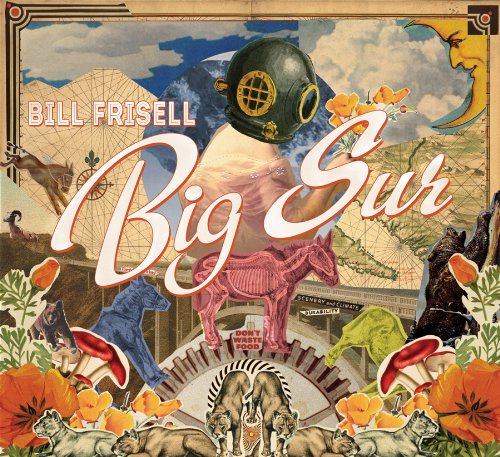
Bill Frisell: Big Sur
At this point in the career of guitarist Bill Frisell, there’s not much point in continuing to talk about his music as “jazz”—or as “Americana” . . . or really as anything for that matter. Frisell has cornered the market on something wholly his own: an instrumental form that uses elements of different genres to create cinematic soundscapes that lope or slither, walk or skitter like a great character making his way across a movie screen.
Big Sur is an outing for the leader’s “858 Quartet”, which is Frisell plus Jenny Scheinman on violin, Eyvind Kang on viola, and Hank Roberts’ cello, plus the drummer Rudy Royston. Frisell wrote this music (19 somewhat connected short tunes) on a commission while staying on a ranch at Big Sur, inspired by classic California coastline. The sound is mostly open and pleasing, and maybe sometimes just a little too nice—a little boring—in the way that beauty sometimes can be.
So, to be sure, this is mostly very “pretty” music, and that may be its glory and its problem. Although there is plenty of folky edge here—a kind of funky sweetness that suggests authenticity—most of the music on Big Sur is consonant, mid-tempo stuff. It’s soulful, like, dig “Highway 1”, with Jenny Sheinman’s violin bending notes and the strings generally playing syncopated patterns over a two-chord groove. Or how about the delightful but lightweight “We All Love Neil Young”, a duet between Frisell and Kang that is a charming minute and a half of skipping guitar and pure melody? Nice stuff.
But very nearly each of these little portraits leans on a certain kind of easy, loping vibe—a dreamy melodicism that comes with all the right kind of “authentic” American/folk affectations. It’s interesting and cool—but I admire this music more than I like it. The tunes feel a bit like museum exhibits. You might say that this music presents you with a bit of a guilt trip: Hey, man, you really should dig this, whether it’s terrific or not, just because it sounds so “real”.
Read the entire review here: Bill Frisell: Big Sur
Wednesday, September 11, 2013
JAZZ TODAY: Later, Marian McPartland
On Tuesday, 20 August 2013, we lost pianist and radio host Marian McPartland. Marian (as everyone called her during her more than four decades in radio) was the best ambassador and educator in jazz history. The music will miss her more than it knows.
Jazz and Radio—a Critical Connection
Radio has been critically important to jazz. All contemporary music, prior to the last ten years or so, has had radio to thank for the way that folks discovered its joys. Jazz, pop, rock ‘n’ roll, soul. For jazz, however, radio was particularly important. During radio’s pre-television heyday, jazz was the star, with Benny Goodman and Duke Ellington among many others surging to public consciousness from dance halls all across the US and into living rooms and parties.
Later, urban jazz DJs promoted and ushered in new jazz styles—most notably bebop, which ascended significantly based on the support of folks like Symphony Sid or Mort Fega. And when jazz became harder to discover in the pop culture landscape of the ‘60s and ‘70s, the word still spread through great jazz stations on public radio in New York, in Chicago, on the West Coast, all over.
Starting in 1964, Pacifica Radio’s WBAI in New York started letting a British jazz pianist from Great Britain—the 46 year-old Marian McPartland—interview guest musicians on the air. In 1978, Marion started the show on National Public Radio that would make her more famous than her own music: Marian McPartland’s Piano Jazz. She kept recording episodes well into 2010, when she was 92 years old.
The effect of this incredible body of work—hundreds of episodes with rare repeat guests—is tough to explain or calculate. But the magic of radio is the thing. When you listened to Piano Jazz, you felt that you were in a room with two real, regular folks—Marian and her guest—who just happened to be talking about one of the most elusive things that exists in the arts: that quicksilver known as jazz improvisation. Because it was radio, you could imagine sitting three feet away from these two folks, maybe sharing the edge of a piano bench with Chick Corea or Ray Charles. You were in on the secrets. It was full-on intimacy.
There was never a radio show that made you feel closer to the divine than this one.
Read the entire column here: Later, Marian McPartland
Wednesday, September 4, 2013
Bassist Stephan Crump, from Pop to Avant-Garde and Back Again
I’ve written before about the singer Jen Chapin, whose style and approach is a perfect example of how “jazz” and “pop” remain in a beautiful dialogue even though Chapin doesn’t sing jazz standards or otherwise hold herself as a “jazz” artist. (“Playing Pop in the Jazz/Soul Shadow”)
Aside from being a fine songwriter and outstanding pop singer, Chapin (the daughter of Harry Chapin, yup) is also married to Stephan Crump, the stylistically catholic jazz bass player. Chapin most commonly performs with Crump—along with guitarists Jamie Fox and Liberty Ellman, which group is otherwise known as Crump’s Rosetta Trio. But Crump is best known as a member of Vijay Iyer’s brilliant jazz trio and for other jazz playing that strays wildly beyond the conventional.
All this is on my mind because Chapin has an irresistible new recording, Reckoning, featuring Crump, Fox, and Ellman as well as a few other folks. It’s yet another example of how smart, contemporary pop can still be soulful and laced with jazz feeling without being “jazz”. And the Rosetta Trio also has a lovely new disc, Thwirl, a stunning essay in chamber jazz that moves from delicate to earthy. And Crump has a new duet recording with guitarist Mary Halvorson called Super Eight that is equally wondrous but that sits at the edge of jazz that is opposite from pop music: fully improvised music without hooks, verse/chorus structure, or anything resembling pop appeal.
All three of these recordings are outstanding. Central to all three is a jazz musician whose refusal to honor boundaries is a badge of honor. Arguably it’s what’s best about today’s jazz musician.
Jen Chapin’s Reckoning
The first sound you hear on the new, terrific, Chapin record is that of Crump’s bass playing a singing groove along with finger snaps and a syncopated drum pattern. The hip rise and fall of the bass melody is a perfect counterpoint to Chapin’s soulful and bluesy verse melody. It’s no surprise, then, that Chapin and Crump have recorded together as just a duet act.
But the appeal of “It’s All Right” goes beyond these two strongest elements. There are Chapin’s words, which provide telling details of difficult life being shared by a couple that is, still, resolved to make it. And it’s all wrapped in a concise arrangement by Crump—a few tastefully deployed strings, sprinkles of percussion, precise interplay between the guitars of Fox and Ellman. The lift of the strings on the chorus isn’t sugary but poignant. It’s wonderful storytelling that works because all the elements work together.
For me, “Let It Show” (a joyful piece of advice for a child, previously recorded by Chapin but not this well) ought to be a hit song—hooky, thrilling, beautiful. And it’s recorded and arranged with perfection: starting with simply strummed acoustic guitar, then layering in bass, guitars, Farfisa organ and Wurlitzer electric piano, even a little touch of glockenspiel. The following song, “Don’t Talk” is equally snappy—a faux reggae song that uses touches of clavinet, a brief little flute line and even a very brief bass “solo” for Crump that appears twice and naturally in the arrangement. That Chapin folds in a sumptuous release that eases of the reggae backbeat and evens out alike a ballad for a half-minute is just gravy.
Not everything on Reckoning is pure pop pleasure, though. “Spare Love (Not Fair)” begins with a duel guitar line that winds in an arcing shape before Chapin joins in counterpoint, all before the band groove sets in. It’s hard not to hear a tune like this as harking back to the kind of complex arrangements that bands like Steely Dan made standard in the ‘70s but that may be out of style in the “indie” atmosphere of the 21st century. But Chapin and Crump aren’t afraid to lay in some harp on this tune. And it works.
The closer on this ambitious record is called “Gospel”, a song that imagines a better world being possible. Again, the arrangement builds from simplicity (an off-center drum and bass groove that allows Chapin to sing a simple blues melody) to great complexity, with a significant harmonized chorus, a piece of spoken-word recitation, Hammond organ and celeste, and then a sensuous trumpet solo from Ambrose Akinmusire on the long out-chorus.
And those are just some of the stand-out tunes on Reckoning—a pop record that means to be, and is, much more than just some catchy licks and some passion. In fact, if you listen without enough attention on the first pass, Chapin’s work might seem “merely” pleasant. But just a little care and attention to the lyrics and arrangements suggests that Crump and Chapin have created a surefire gem: the kind of carefully-crafted and sophisticated pop that used to be associated with Paul Simon. Yeah, it’s that good.
So, a jazz bass player is making brilliant pop records—like Jaco Pastorius used to to with Joni Mitchell. But is his own jazz playing much to hear?
The Rosetta Trio’s Thwirl
It very much is.
The heart of Chapin’s band on Reckoning is actually Crump’s band. Or, rather, one of his bands. Crump’s acoustic bass along with guitarists Jamie Fox and Liberty Ellman make up The Rosetta Trio. As the heart of a group playing a jazzy pop for Chapin, these guys bring elegance and groove to songs that might have been played without soul. In two earlier records, this band has created an identity as an instrumental jazz trio that deserves a wider hearing.
Thwirl is the trio’s new record (out in September), and I think it is their best—impressionistic at times, but also soulful and singing, interlocking like a beautiful puzzle and also playful and witty. Crump play several different roles in this band—groovemaker on a playful 5/4 tune like “He Runs Circles” or a loping slow soul exercise like “Still Stolid”; primarily melodist on something like “Conversate (Talking-Wise)” or arco balladmaster on start of “Ending” or on the hypnotic middle section of “Whiteout”; or free improvising master on “Palimpsestic”, which begins as a pointilistic exploration and builds into a funky set melody that is irresistible.
Crump’s bandmates here are complimentary—almost to a fault but somewhat surprisingly. Ellman is known for his work in Henry Threadgill’s Zooid band and his association with Vijay Iyer, Rudresh Mahanthappa, and Steve Lehman. Fox’s resume sets him up as a much more conventional player—he was lead guitarist for Blood, Seat & Tears and played with Joan Baez, organist Brother Jack McDuff, and Dr. John. But as bandmates, Fox and Ellman weave a brilliant and seamless cloth of chords, melodies, effects, and textures. I don’t find it easy to tell them apart. The title track, for example, is a polyrhythmic workout, with the guitarists plucking in a percussive maze that evolves into a circular melody that trades from one player to the other. It’s a joy to hear the interplay and selflessness as one statement leads to another.
All the tunes but one were written by Crump, and they show a stylistic diversity that is the equal of, say, bassist Dave Holland. In fact, Holland is the player who might be Crump’s artistic predecessor: someone just as home playing melodically, playing in a pop frame, or roaming free with little harmonic structure. Both have a pungent sound, rich in bottom while still capable of rising up to grab the music’s spotlight.
Thwirl is a truly satisfying record because, like so much of Holland’s work, it is catchy and appealing without ever seeming like it has “sold out” to ease or simplicity. That is to say: though it is perfectly “serious” jazz, it isn’t afraid to appeal a listener’s sense of pop pleasure. Which makes sense if you know that Crump is also a key force in Chapin’s sound.
But, it turns out, he can cut loose, wildly loose, too.
Secret Keeper’s Super Eight
Crump’s duet project with guitarist Halvorson is called “Secret Keeper”, which is a wonderfully suggestive title for a collaboration that is intimate, revealing, and cagey all at once.
Read the entirety of the column here: Bassist Stephan Crump, from Pop to Avant-Garde and Back Again
Subscribe to:
Posts (Atom)