In jazz as in most things, I tend to prefer the subtler stuff, not the highest notes of the loudest playing. Maynard Ferguson would be my LEAST favorite jazz trumpeter, particularly after an adolescence in which all the high school trumpet players idolized him and had barely heard of Miles Davis.
But Freddie Hubbard was different. His frequent and spectacular flights into the upper register had a daring harmonic purpose. As he proudly knew, he sounded more like a saxophone player than a trumpeter in the way he serpentined his way up there, playing harmonically daring lines that shot into the stratosphere with real jazz daring. If you don't know it by heart already, I'm begging you to go now and listen to Freddie's brilliant solo on Herbie Hancock's classic "Maiden Voyage."
As a bandleader, Freddie was a mixed bag. He might be remembered more for this time with Art Blakey and the Jazz Messengers or for his countless Blue Note records (as a leader and as a sideman) that were not necessarily with working groups. But in the 1970s and '80s he led some hot bands on the strength of his successful CTI recordings (Red Clay, First Light) and some commercial stuff he did for Columbia that is mostly better forgotten.
Freddie Hubbard: Pinnacle Live and Unreleased from Keystone Korner(reviewed in full on PopMatters here) collects some hot 1980 recordings from San Francisco's Keystone Korner, and great club. Billy Childs is on piano, and his playing is fully up to Hubbard's. The rest of playing is merely very good, but as a group these guys were seriously cookin'. And Freddie himself was probably never in better shape with his chops, his ideas, and his sense of freedom within the band.
The tunes offered here are a fine cross-section of the mid-career Freddie: "The Intrepid Fox" from Red Clay, "One of Another Kind" from the VSOP dates with Hancock, Shorter, Carter and Williams, "Blues for Duane" and the terrific "First Light." In addition, Hubbard plays it pretty on Michel LeGrand's Summer of '42 theme and plays a grrrrrreat and athletic solo on "Giant Steps"—the only recording of that jazz classic by Freddie, at least that I know of.
This is more than nostalgia, but it also reminds us that from 1980 onward Hubbard's best days were behind him. In 1992 he burst his lip, then it got infected and he was never the same as a player. In 2008 he died of congestive heart failure, having to be bailed out of financial trouble by friends. I prefer to remember him as a swaggering great of his horn.
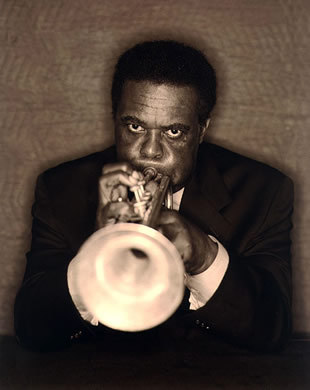
I actually ran into him on the street one night. I was at DC's old One Step Down to hear Woody Shaw play with a local rhythm section, and Freddie was at Blues Alley with McCoy Tyner's trio. After his set, Freddie was strolling down Pennsylvania Avenue with a beautiful date. He was wearing a lovely coat and a fedora, and I recognized him from a block away—his stride and his confidence and his lip too, messed up by years of that hard, beautiful playing. Woody had sounded great, and it was a fine night. Freddie played with Woody Shaw around that time and I guess they were friends. As Freddie approached me, he sized me up and then asked me, "Where's Woody?" drawing out the word "where's" with a great long breath. I was too stunned to answer and just pointed at the One Step.
Where's Freddie? Gone, but with this disc suddenly here, still remembered and heard.
Header Quote
"If you ain't got it in you, you can't blow it out."
— Louis Armstrong
Monday, October 10, 2011
Wednesday, September 28, 2011
John Scofield: A Moment's Peace
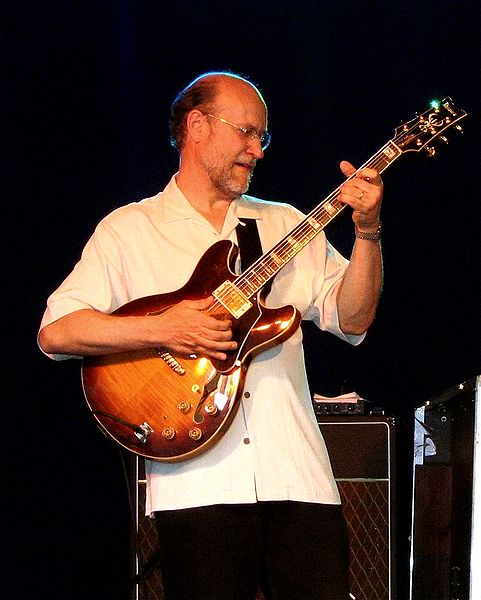
I really really like guitarist John Scofield. His start with Mingus and Chet Baker, his stint with post-comeback Miles, his fusiony bands in the early 1980s and then his killer string of discs on Blue Note and Verve: great stuff.
But when he became a kind of "jam band star" with the superfine disc A Go Go (with the trio Medeski, Martin, and Wood), things maybe soured a little. A bunch of his records after that seemed a little puffed up with affectation—not all of them, nope, but certainly Uberjam and its live follow-up, which seemed like lowest common denominator stuff for a guy who wasn't into coasting.
If Sco's career in the last dozen years has been up and down, then his new disc, A Moment's Peace, is up-up-up. Featuring a brilliant band (Larry Golding, Brian Blade and Scott Colley) and a wonderful mix of standards, pop songs and originals, this is a quietly daring recording.
The band’s treatment of standards is similarly quirky and strong throughout. “You Don’t Know What Love Is” is given a fresh take—with Goldings playing a pulsing kind-of-reggae offbeat figure throughout. Blade’s rhythm approach, however, works somewhat against that groove, with jazz accents and melodic rolls acting like a gentle version of what Elvin Jones might have played on this kind of tune. Goldings solos memorably over the “A” sections, setting up Sco for a fluid and sharp statement on the bridge.
Both “Gee, Baby, Ain’t I Good to You” and “I Want to Talk About You” are played in a more conventional jazz style, but both are superb. “Gee Baby” catches Scofield in note-bending mood, like a weirder, subtler B.B. King. Every note is clear and tangy. The Eckstine tune moves Goldings over to piano, where he is just fine. Colley comes through in the mix more completely, letting the partnership with Blade shine at mid-tempo. As Scofield tackles the tougher harmonic path on “Talk About You”, the rest of the band sets up beautiful polyrhythms behind him. Now, this is no jam band in the popular sense, but the group dynamics and sense of play here are outstanding. Everyone in the band is cooking, but there isn’t a cliché in sight.
This is a band that is exceptional at setting a mood. Blade’s mallet work combines with Golding's piano to prepare Sco for a lovely reading of “Throw It Away”, a tune by Abbey Lincoln. Carla Bley’s “Lawns” gets a treatment that is quietly warm, with just a hint of strut in its step. And several Scofield originals are typically hard to get out of your head.
Maybe one of finest jazz records of the year, A Moment's Peace makes John Scofield seem a little less jammy and whole lot relevant and cool.
But when he became a kind of "jam band star" with the superfine disc A Go Go (with the trio Medeski, Martin, and Wood), things maybe soured a little. A bunch of his records after that seemed a little puffed up with affectation—not all of them, nope, but certainly Uberjam and its live follow-up, which seemed like lowest common denominator stuff for a guy who wasn't into coasting.
If Sco's career in the last dozen years has been up and down, then his new disc, A Moment's Peace, is up-up-up. Featuring a brilliant band (Larry Golding, Brian Blade and Scott Colley) and a wonderful mix of standards, pop songs and originals, this is a quietly daring recording.
The band’s treatment of standards is similarly quirky and strong throughout. “You Don’t Know What Love Is” is given a fresh take—with Goldings playing a pulsing kind-of-reggae offbeat figure throughout. Blade’s rhythm approach, however, works somewhat against that groove, with jazz accents and melodic rolls acting like a gentle version of what Elvin Jones might have played on this kind of tune. Goldings solos memorably over the “A” sections, setting up Sco for a fluid and sharp statement on the bridge.
Both “Gee, Baby, Ain’t I Good to You” and “I Want to Talk About You” are played in a more conventional jazz style, but both are superb. “Gee Baby” catches Scofield in note-bending mood, like a weirder, subtler B.B. King. Every note is clear and tangy. The Eckstine tune moves Goldings over to piano, where he is just fine. Colley comes through in the mix more completely, letting the partnership with Blade shine at mid-tempo. As Scofield tackles the tougher harmonic path on “Talk About You”, the rest of the band sets up beautiful polyrhythms behind him. Now, this is no jam band in the popular sense, but the group dynamics and sense of play here are outstanding. Everyone in the band is cooking, but there isn’t a cliché in sight.
This is a band that is exceptional at setting a mood. Blade’s mallet work combines with Golding's piano to prepare Sco for a lovely reading of “Throw It Away”, a tune by Abbey Lincoln. Carla Bley’s “Lawns” gets a treatment that is quietly warm, with just a hint of strut in its step. And several Scofield originals are typically hard to get out of your head.
Maybe one of finest jazz records of the year, A Moment's Peace makes John Scofield seem a little less jammy and whole lot relevant and cool.
Wednesday, September 21, 2011
Farmers by Nature: Out of This Worlds Distortions
There is extreme playfulness in the bloodline of the trio Farmers by Nature: Craig Taborn on piano, William Parker on bass and Gerald Cleaver's drums. “Sir Snacktray Speaks” puts together a jabbing little jig from Taborn’s piano with an aching set of held bowed tones on Parker’s bass to generate a smiling theme. Then Cleaver takes over for a cluttered drum lead that scampers over a Parker pizzicato line. Then Taborn reenters, with a moody set of locked-hand chords, which sets up Parker to return to his bow for some down-home fiddle figures.
If it’s a lovely ballad you hanker for, then the opener, “For Fred Anderson” (a reference to the recently passed Chicago free tenor player), is a haunting, lovely theme. Taborn rings his keys with the sustain pedal down, getting a series of beautiful overtone resonances—a bed of stunning sound over which Parker plays very quiet bowed tones. The texture of this performance is spare and transparent, but Cleaver thickens it with subtle cymbal and percussion work.
The title track of Out of This World’s Distortions may be its highlight. Parker begins with a stately plucked melodic over pulsing cymbals. Taborn eventually enters with a set of sculpted rising patterns that are not the theme as much as a framing accompaniment. Over time, this balanced conversation draws you in, seeming to ask a million questions without providing obvious answers. You might listen to it 10 times, concentrating on different elements each time.
Read my full review of the recording HERE.
Each of these performances makes the case that “free jazz” is not a forbidding mess but rather an open plain of possibilities. Farmers by Nature is a band that takes seriously its mission to communicate to listeners, even though there is not a compromise in sight. The music is not appealing because it is familiar but because it sounds grounded, rooted, in basic patterns and in a connection to emotion.
Craig Taborn, William Parker and Gerald Cleaver move as one on this record. And if you give the music half a chance, you move with them.
If it’s a lovely ballad you hanker for, then the opener, “For Fred Anderson” (a reference to the recently passed Chicago free tenor player), is a haunting, lovely theme. Taborn rings his keys with the sustain pedal down, getting a series of beautiful overtone resonances—a bed of stunning sound over which Parker plays very quiet bowed tones. The texture of this performance is spare and transparent, but Cleaver thickens it with subtle cymbal and percussion work.
The title track of Out of This World’s Distortions may be its highlight. Parker begins with a stately plucked melodic over pulsing cymbals. Taborn eventually enters with a set of sculpted rising patterns that are not the theme as much as a framing accompaniment. Over time, this balanced conversation draws you in, seeming to ask a million questions without providing obvious answers. You might listen to it 10 times, concentrating on different elements each time.
Read my full review of the recording HERE.
Each of these performances makes the case that “free jazz” is not a forbidding mess but rather an open plain of possibilities. Farmers by Nature is a band that takes seriously its mission to communicate to listeners, even though there is not a compromise in sight. The music is not appealing because it is familiar but because it sounds grounded, rooted, in basic patterns and in a connection to emotion.
Craig Taborn, William Parker and Gerald Cleaver move as one on this record. And if you give the music half a chance, you move with them.
Monday, September 19, 2011
A Dear John Letter to Jazz: To Hell with Loving You
Well, here it is: an announcement of intention. A decision, long mulled over. A cry for help in the lonely jazz night.
Why be faithful to jazz? What has she ever really done for me? Who's she running around with on the side? When people see me, then think of her, what's really going on in their heads?
Well, I'm done.
My resignation, of a sort. Read the kiss-off RIGHT HERE.
A love affair, ended, and then . . . ?
Why be faithful to jazz? What has she ever really done for me? Who's she running around with on the side? When people see me, then think of her, what's really going on in their heads?
Well, I'm done.
My resignation, of a sort. Read the kiss-off RIGHT HERE.
A love affair, ended, and then . . . ?
Friday, September 9, 2011
Ornette Coleman: Something Else!
Every revolution has to start somewhere, and often the beginnings are not particularly unsettling. That was certainly the case with Ornette Coleman and his "free jazz" style. Or was it? At the time, people reacted to Ornette as if he had taken a poop in his horn and set it on fire.
Looking back at his first album Something Else! (read my full PopMatters review HERE), it seems like Ornette was just a slightly ornery bebopper with a loose sense of intonation. It sounds pretty mainstream. The themes are spirited and tonal, and the whole enterprise certainly swings like mad. In the original liner notes, Ornette states: “I think that one day music will be a lot freer”. Even the artist did not think it was there yet.
Pianist Walter Norris and bassist Don Payne are simply playing bebop—just listen to their solos on “Angel Voice” and you will hear utterly conventional bop playing of the late ‘50s. And Billy Higgins’ drumming, while fluid and simpatico with Coleman in every moment, swings in conventional time. It is notably less “out” than the work of, say, Max Roach or Art Blakey from the same era. Don Cherry on "pocket trumpet" is also playing bebop, but he is closer to Coleman in concept. His long solo on “Alpha” is a clear balance. On the one hand, Cherry crackles with licks that run across the harmonies, just as if he were Kenny Dorham. On the other hand, there is a raggedness to his tone in places, and he has developing a way of abstracting the harmonies without really playing “wrong” notes.
The leader, however, is already free on his solos. Not only does Coleman use an off-putting and highly vocalized tone, but he tends to play flat in ways that makes all his notes sounds like blues tones. Then, when actually selecting notes and building phrases, he does not necessarily follow the chord patterns that Norris and Payne are playing. On “The Blessing”, which is a wonderful and attractive theme over the “I’ve Got Rhythm” chord changes, Coleman’s line is significantly in conflict with the first pattern. On “Alpha”, Coleman sounds a good bit like Eric Dolphy in the way he follows his own sense of vocal patterns down interesting melodic allies.
Listening to the whole package in 2011, it's clear that there was, in fact, a revolutionary player and thinker leading this enterprise. He just didn't have his concept full actualized yet, and his bandmates weren't quite on board. A mere year or so later, he would have Charlie Haden on bass and eventually Ed Blackwell on drums, dropping the piano. The revolution—though lovely and lyrical in many places—would arrive.
But it started here.
Looking back at his first album Something Else! (read my full PopMatters review HERE), it seems like Ornette was just a slightly ornery bebopper with a loose sense of intonation. It sounds pretty mainstream. The themes are spirited and tonal, and the whole enterprise certainly swings like mad. In the original liner notes, Ornette states: “I think that one day music will be a lot freer”. Even the artist did not think it was there yet.
Pianist Walter Norris and bassist Don Payne are simply playing bebop—just listen to their solos on “Angel Voice” and you will hear utterly conventional bop playing of the late ‘50s. And Billy Higgins’ drumming, while fluid and simpatico with Coleman in every moment, swings in conventional time. It is notably less “out” than the work of, say, Max Roach or Art Blakey from the same era. Don Cherry on "pocket trumpet" is also playing bebop, but he is closer to Coleman in concept. His long solo on “Alpha” is a clear balance. On the one hand, Cherry crackles with licks that run across the harmonies, just as if he were Kenny Dorham. On the other hand, there is a raggedness to his tone in places, and he has developing a way of abstracting the harmonies without really playing “wrong” notes.
The leader, however, is already free on his solos. Not only does Coleman use an off-putting and highly vocalized tone, but he tends to play flat in ways that makes all his notes sounds like blues tones. Then, when actually selecting notes and building phrases, he does not necessarily follow the chord patterns that Norris and Payne are playing. On “The Blessing”, which is a wonderful and attractive theme over the “I’ve Got Rhythm” chord changes, Coleman’s line is significantly in conflict with the first pattern. On “Alpha”, Coleman sounds a good bit like Eric Dolphy in the way he follows his own sense of vocal patterns down interesting melodic allies.
Listening to the whole package in 2011, it's clear that there was, in fact, a revolutionary player and thinker leading this enterprise. He just didn't have his concept full actualized yet, and his bandmates weren't quite on board. A mere year or so later, he would have Charlie Haden on bass and eventually Ed Blackwell on drums, dropping the piano. The revolution—though lovely and lyrical in many places—would arrive.
But it started here.
Friday, August 26, 2011
Cannonball Adderley with Bill Evans: Know What I Mean?
The opening strains of this classic Riverside album are pure-pure delicacy that could only come from the fingers of Bill Evans. His chiming piano, playing the original “Waltz for Debby”, is something that brings to mind a particular kind of jazz—intimate, sweet, contemplative. Then, 1:07 in, Percy Heath’s bass burbles downward and Connie Kay’s brushes start working against a snare—and the ripe sound of Cannonball Adderley’s alto sax just pops into the tune. Yummmmm.
This tune alone—the most swinging of all the “Debby”s ever recorded and one that is my all-time favorite example of a waltz suddenly busting into swinging 4/4—makes Know What I Mean? a classic, must-have jazz album. Read my full review HERE.
Of course, Adderley and Evans played together in the classic Miles Davis band—the one that recorded Kind of Blue, no less—so they were familiar with this particular sweet-and-sour set up. And this simpatico teamwork shows throughout this disc. There are lovely ballads on which Adderley nevertheless finds a blues strain, and there are skipping swingers on which Evans is perfectly at home.
The modal tune "Know What I Mean?" is particularly intriguing, with Adderley at home while playing flutters against a set of scales, then a whispered piano solo in that mode. At the mid-point, however, Kay sets up a jagged Latin groove for Cannonball’s solo, shifting gears into straight 4/4 swing only to find Evans soloing over the bolder groove as well. The shift back to brushes and ballad tempo is sudden and dramatic.
It's great, then, to hear the alternate take of this tune included on this reissue. This unused take moves into the groove section much sooner and finds Adderley stretching out more expansively and then re-entering over the groove just as the rhythm section switches into a bit of double-time 12/8. Clearly the band was fooling around with this arrangement in the studio, and it’s great to hear part of the creative process here—with the unused take making more sense, I think, of this shape-shifting tune.
The whole disc contains a bounty of great music. If you love jazz but don't know this album: stop reading. Get it now.
This tune alone—the most swinging of all the “Debby”s ever recorded and one that is my all-time favorite example of a waltz suddenly busting into swinging 4/4—makes Know What I Mean? a classic, must-have jazz album. Read my full review HERE.
Of course, Adderley and Evans played together in the classic Miles Davis band—the one that recorded Kind of Blue, no less—so they were familiar with this particular sweet-and-sour set up. And this simpatico teamwork shows throughout this disc. There are lovely ballads on which Adderley nevertheless finds a blues strain, and there are skipping swingers on which Evans is perfectly at home.
The modal tune "Know What I Mean?" is particularly intriguing, with Adderley at home while playing flutters against a set of scales, then a whispered piano solo in that mode. At the mid-point, however, Kay sets up a jagged Latin groove for Cannonball’s solo, shifting gears into straight 4/4 swing only to find Evans soloing over the bolder groove as well. The shift back to brushes and ballad tempo is sudden and dramatic.
It's great, then, to hear the alternate take of this tune included on this reissue. This unused take moves into the groove section much sooner and finds Adderley stretching out more expansively and then re-entering over the groove just as the rhythm section switches into a bit of double-time 12/8. Clearly the band was fooling around with this arrangement in the studio, and it’s great to hear part of the creative process here—with the unused take making more sense, I think, of this shape-shifting tune.
The whole disc contains a bounty of great music. If you love jazz but don't know this album: stop reading. Get it now.
Tuesday, August 23, 2011
The Off-Handed Cool of Michael Franks
Back in the '70s when I was first getting into jazz, it was great to discover the Reprise debut of the singer and songwriter Michael Franks. The Art of Tea was hip and swinging and funny, which is to say that a bunch of the songs were sly winks full of clever wordplay. They were sexy but smart. Franks, as a singer, was subtle and barely there, but he was backed by a collection of cool musicians drawn mostly from the band the Jazz Crusaders. "Popsicle Toes" and "Eggplant" and "Sometime I Forget to Smile" were cookin' little swingers that I wished I was cool enough to sing myself.
Over time, Franks demonstrated that he was also heavily influenced by Antonio Carlos Jobim—he was a great writer and singer of sophisticated bossa novas, and his ballads were great too. But as the albums tumbled onward toward the 1980s, the mushy side of Franks emerged as well. He preceded but was, essentially, pre-made for the "smooth jazz" sound, and I stopped paying attention to him at some point in the next decade.
Now he is back with a new record, Time Together (read my review HERE), and it surely reminds of what I always loved about Franks. So I made a more complete profile of him into this month's column, JAZZ TODAY: The Off-Handed Cool of Michael Franks, clickable here.
In any case, looking back, I think it's fair to say that Franks has always been an amazing songwriter and—in fact—a fine jazz singer. That he got gooped up in all that smooth jazz cotton candy doesn't change the fact that his songs are beautiful and well-written. And maybe, with the smoove jazz haze finally parting these days, he's back to being cool again?
Over time, Franks demonstrated that he was also heavily influenced by Antonio Carlos Jobim—he was a great writer and singer of sophisticated bossa novas, and his ballads were great too. But as the albums tumbled onward toward the 1980s, the mushy side of Franks emerged as well. He preceded but was, essentially, pre-made for the "smooth jazz" sound, and I stopped paying attention to him at some point in the next decade.
In any case, looking back, I think it's fair to say that Franks has always been an amazing songwriter and—in fact—a fine jazz singer. That he got gooped up in all that smooth jazz cotton candy doesn't change the fact that his songs are beautiful and well-written. And maybe, with the smoove jazz haze finally parting these days, he's back to being cool again?
Subscribe to:
Posts (Atom)