Header Quote

"If you ain't got it in you, you can't blow it out."
— Louis Armstrong

Wednesday, August 5, 2015

The Bad Plus Joshua Redman - Brubeck-ian New Jazz

There’s been so much revolution among jazz piano trios in recent years, and accounts of the trend inevitably point to the Bad Plus: Ethan Iverson (piano), Reid Anderson (bass), and Dave King (drums). The band has a wide range and can “swing” in a traditional way when it so chooses, but the Bad Plus have mainly produced a series of highly structured compositions and strategies for instrumental drama and improvisation, and they have been catchy and cool enough to bring the band significant mainstream success.

It’s only with the release of The Bad Plus Joshua Redman, the band’s first recording with another major player, that I realized that the Bad Plus might be understood as the Dave Brubeck Quartet of our era.

Huh?

Dave Brubeck, forever known to the public for “Take Five”, was the most popular and prominent jazz musician of his heyday (the late ‘50s and early ‘60s), but his success was improbable and idiosyncratic. He famously wrote and played tunes in odd meters, his piano playing was “heavy” and often bombastic (though he played gently too, and beautifully), his music could be jokey or gimmicky at times and yet he wrote jazz standards too, he courted a fervent following among younger fans who got hipped to jazz by his band, and his band featured a swinging saxophone player whose style very much offset his own and whose fame and jazz legitimacy nearly outshone him.

That’s a pretty good description of the Bad Plus, until you get to that last part about a jazz saxophonist. And now the trio has been supplemented on record and on its recent tour by tenor saxophonist Joshua Redman, a very swinging modern master whose jazz fame precedes and might exceed that of his new collaborators. Redman, the son of Dewey Redman and a Harvard graduate, won the 1991 Thelonious Monk International Jazz Saxophone Competition, and he quickly developed a high profile career at a time when such careers were about to fade away with the fortunes of the record industry. Is Redman a natural match for the Bad Plus? Probably not. And that is the wonder and joy of it.

The Bad Plus Joshua Redman is every bit a Bad Plus record. Both the songs and the song titles are clever and idiosyncratic in the manner of previous Bad Plus work. “County Seat” has a jabbering and funky theme for tenor and piano that shuffles through quick changes in time signature such that, well, forget about tapping your toe. And yet it’s a groovy feeling tune, irresistible really, until it moves into a wild section that pits Redman against King in pure free-blowing style and then, zip-zap-zop, it’s back to the groove — and done in barely three minutes. Fun, odd, playful, and full of flavors.

Read the entire review HERE AT POPMATTERS.

Friday, July 24, 2015

Robert Glasper: Covered (Recorded live at Capital Studios)

If you listen to early recordings by Thelonious Monk, Bill Evans, Herbie Hancock, or McCoy Tyner, you will hear some superb but relatively conventional jazz pianism. Playing as sidemen with older talents, they were more likely to stick to the script of the moment. But within less than a decade, each would become idiosyncratically themselves, developing an individual vocabulary they had nurtured over some time and moving its quirks to the center of their art. In essence, they became more utterly themselves, to the point where just a bar or two or their playing made it clear that only they could be at keys.

If you listen Robert Glasper’s first Blue Note disc as a leader, 2005’s Canvas, similarly you hear only the prototype, the beginnings of a wholly individual voice. It’s there, a new sound, but there is still plenty of playing that might be someone else or someone coming from similar influences.
On Covered, his latest recording (but, like the early ones, a strictly acoustic jazz trio record) there is no more mistaking Glasper for anyone but himself.

Today, Robert Glasper has about as distinctive a profile as you can have in jazz. He is a Grammy-winning leader of several bands, an in-demand producer for other artists, as well as a prolific session player. He has a distinctive sound that makes him immediately identifiable on any record. He’s big enough that, on the new record by bassist and producer Marcus Miller, he plays a Fender Rhodes electric piano solo on just one song — one song on which a regular band member plays the Rhodes accompaniment. That’s how special he is.

Although Glasper is undoubtedly a jazz player, his Grammy is not for jazz. And much of his production and sideman work has been in hip hop. And his new recording for Blue Notes sits right on the line; intriguingly so.

Back from years of silence is Glasper’s acoustic jazz trio (with Vicente Archer on bass and Damion Reid on drums) playing songs mostly from Glasper’s two R&B-ish Black Radio records: tunes by Glasper, Macy Gray, Radiohead, Musiq Soulchild, Joni Mitchell, Jhene Aiko, John Legend, and Bilal Oliver. Does that make Covered a jazz recording of “new standards”? Not in the conventional sense, as this trio has largely transformed the language of an acoustic jazz piano trio to adapt it to a new set of rhythms and habits that are deeply informed by hip hop and its musical cousins. Robert Glasper doesn’t “swing” these pop songs (which is an old idea he’d hardly bother with).

Instead, what emerges on Covered is the full extent to which Robert Glasper has matured as an individual stylist. Today, he sounds utterly Glasper on everything he plays, no matter the source material or context. I’m not saying he is as great or important as Monk or Tyner, of course, but he is now as distinctive.

Take his new “Stella by Starlight”. He begins unaccompanied in a tumbling rush of notes that track the well-known harmonies of a thousand other versions. But the attack is rhythmically distinctive, quickly breaking into Glasper’s signature sound: a fluttering arpeggiation of chords and melody that offsets his right and left hand by portion of a beat. It gives his acoustic piano a slightly processed sound, as if he had run it through a mental “chorus” pedal. Soon, Archer and Reid are in, but this is hardly a “jazz ballad” performance by the trio. Archer is thumping “the one” in his own stuttered heartbeat pattern, and Reid is playing quadruple-time brush hits against his snare, chittering and syncopating, almost as if he were performing impossibly fine and fast scratching on a turntable. Glasper’s improvised runs are set against “Stella” harmonies, but what seems to be a shortened and altered sequence of chords, such that when the melody returns it is just a sketch of itself.
There are other tunes where Glasper has chosen a melody and harmonic structure that is already fully to his liking. Joni Mitchell’s “Barangrill” barely requires a transformation, as the songwriter’s floating sense of harmony and spinning melody is right in Glasper’s bag. His style also seems beautifully suited to Radiohead on “Reckoner” (from In Rainbows) with a simple melody a pulsing chords in a deceptively not-that-simple pattern pass from drone into groove. Each song gives Glasper a chance to improvise in probing lines against a groove.

Read the whole review HERE AT POPMATTERS.

Repost from 2006: Jazz Today: The Strange, Mixed Fate of Steely Dan

Back in 2006 (wow, I am older than old), I wrote this JAZZ TODAY column for PopMatters that has since passed out of 'net availability. (Doesn't everyone claim that once it's on the internet it can never go away?)

Because the topic remains highly relevant, here it is again:

Jazz Today: The Strange, Mixed Fate of Steely Dan


By Will Layman


If you're a jazz fan of my vintage -- born in the early '60s and raised in the soft-rock '70s suburbs -- then your favorite rock band is very likely Steely Dan.  Arguably the most jazz-informed rock band of all time, The Dan combined harmonic sophistication with guitars and sardonic lyrics.  And, amazingly: hit songs -- "Reelin' in the Years", "Deacon Blues", "Hey Nineteen".


But in 2006, being a Dan Fan is no picnic.  Most of your hippest friends think you suffer from a streak of bad taste run wildly amok.


 This fact -- and it is a stone cold truth-and-a-half -- sends me into musical lament.  O, why-oh-why is Steely Dan so reviled by today's rock aficionados and indie-pop hipsters?  Must I really live in a world where my recent attendance at a Donald Fagen solo concert (supporting his new album Morph the Cat) is a shameful secret to be hidden from all those under the age of 40?  Can it be true -- can it?! -- that Steely Dan truly is nothing more than a mush of smoove jazz topped with indecipherable lyrics -- an abomination that simply hypnotized us in the '70s because we didn't know any better?


These questions haunt me.  And so I've set out to stare them down, speak to the critics, face my own fears, and evaluate the jazz-rock legacy of Steely Dan.


Herein, I issue my findings:


Part One:  Steely Dan Sucks

A haiku posted on the Internet:


I hate Steely Dan

With a bright purple passion

But some songs are good


Despite my DanFandom, I have consulted with the critics and found that they have a case.  A pretty good one.  The case against Steely Dan can be summarized thusly: cheese. Specifically, Velveeta.


Washington Post concert reviewer Dave McKenna, reviewing that Donald Fagen concert I attended, gets right to the point, calling Fagen's music "processed to such a degree that one could believe it was intended to be played while sitcom credits roll, or between floors. But a whole lot of folks, including the mostly middle-aged fans who cheered every note at the Warner, never regarded Fagen's stuff as Muzak to their ears."


There it is in a nutshell.  Steely Dan's "processed" sound is modern elevator music.  It's a mushy, soft thing -- devoid of rough edges and perfect for pacifying middle-aged music fans.


But what makes it so?  The clean funk beats layered with Fender Rhodes and organ.  The slinky and perfect female background vocalists.  The wedding-band-ish small horn section that adds orchestration to nearly all the songs. Guitarists who play clean, fleet solos with limited distortion.


McKenna incisively calls the Steely Dan records "almost anti-rock records".  He then immediately damns the band as precursor to the Devil he-self: "After all these years, it seems obvious that were it not for the fantastic commercial success of [Steely Dan], programmers at mainstream FM stations might never have foisted subsequent smooth-jazz purveyors from Chuck Mangione to Kenny G on the masses.


Ouch.  But there's truth there.  The Dan not only sound kind of smoove, but those stations put tunes like "Time Out of Mind" in their rotation.  And listen to this, a comment I found posted on the Ben Folds web site in response to a reference to Becker and Fagen: "Steely Dan? YESSS!  Dude!  I totally bought the new Spyro Gyra!  It rox my sox hardcore!"  This alone is reason to suspect Steely Dan of something deeply evil.


McKenna calls it a "quiet-storm ambiance", and a mysterious anonymous source I consulted expresses it in his spelling -- Steely Dan are "lyte-n'-smooth-70's-jazz-rockers".  Mystery Man adds:  "I can enjoy them in measured doses.  Compositionally is where they lose me -- they get too Berklee [College of Music], too often.  There are few things that I dislike more in songwriting than tonally meaningless bridges and interlude sections.  Becker and Fagen seem to be master craftsmen at that."


And that's the other primary element in the Steely Dan Cheese Factor: the band's reputation for being "master craftsmen" rather than rockers -- studio perfectionists who are uninterested in the rock aesthetic of "rawness" or spontaneous edge. A 1998 article from Pulse lumped Steely Dan in with the Eagles as "studio obsessed" -- a reputation Becker and Fagen have certainly earned.  Their records are engineered within an inch of their lives, and the band is famously, not a band at all -- just a couple of songwriters in love with bebop harmony and their own dystopian imaginations.


Analysis aside, there seems to be something innately off-putting about Steely Dan's music.  Particularly if you are under 40, this dislike can be visceral and overwhelming. For example, a comment posted on the website for a band called "Moonshine Still", which apparently did a cover of The Dan's "Night By Night" at a show in July of 2003, states:  "Steely Dan is my least favorite band in the entire history of music. They gross me out. I can't really explain it, but I've always felt this way about them." One of my most incisive and talented musician friends puts it more graphically: "My loathing of Steely Dan is near 100%, though I can't pin specifics on it at all.  I suppose it's a subconscious thing, like thinking milk is always going to have gone bad, or the way dogs can sniff out cancer.  I'm connately put off by them."


This guy, a guitarist, can find no use for The Dan, not even their carefully crafted and obsessed-over guitar solos.  "It feels like posturing.  Awesome guitar inside a shit song makes the awesome guitar seem clownish or something."


And so it is: cheesy, clownish, processed, and laying the groundwork for smoove jazz.  How can you even think of defending this band?


Part Two:  Steely Dan, Triumphantly Uncool

In the mid-70s, the case for Steely Dan was plain: they write great, uniquely weird songs.  This was back before Reagan, when weird was still kind of cool and when having a jazz attack in your pop music was kind of hip.  The electric pianos and saxophone solos were edgy, not Mangione.


Indeed, back then, it was precisely Steely Dan's geeky "anti-rock" posture that made them a cool kid's obsession: a couple of great musicians who -- quite oddly -- fit gorgeous jazz-laced melodies to lyrics about madmen and child molestors.


My Mystery Source puts it nicely -- Steely Dan were never superficial poseurs but, rather, nerd heroes:  "I don't get posturing out of Steely Dan.  They seem like a bunch of geeky musicians, sitting around, basically trying to make something pretty that, in the end, is still pretty geeky.  Whether I actually like it or not is another story, but it all comes across as genuine to me."


And that was the Steely Dan mystique -- they were cats who could and would cover a Duke Ellington song ("East St. Louis Toodle-oo", from Pretzel Logic) and write an original about the brilliance of Charlie Parker ("Parker's Band") yet would also turn out genuinely strange songs that told the weirdest possible stories. If the textures of the songs were somewhat soft rock, then, well -- that was part of the irony and weirdness of music!  As Mystery Man puts it, "As far as the-slickness-to-the-point-of-sterility thing, I guess I find something intriguing about that too, as in, they are the only band that sounds like that."


How weirdly nerdy can you get? -- "Steely Dan" is the name of a dildo in William Burroughs' cut-and-paste classic novel, Naked Lunch.


As befit a couple of jazz-influenced nerd-rockers, Walter Becker and Donald Fagen knew enough to hire some seriously sick players for their recordings.  In the original version of the band, they had two crazy guitarists -- Denny Dias and Jeff "Skunk" Baxter -- who gave the tricked up songs some Stratocaster edge.  Songs like "Reelin' in the Years" and "My Old School" may have had "lyte" textures, but they also featured mad solos. And when the Dan ventured further into the studio and jazz musicians of New York and LA, they found monster players on every instrument: Steve Gadd or Dennis Chambers on drums, Chuck Rainey or Tom Barney on bass, guitarists as diverse as Eliot Randall, Larry Carlton, Rick Derringer and Wayne Krantz, and a list of all-star jazz saxophonists that is almost embarrassing to recite: Phil Woods, Jerome Richardson, Wayne Shorter, Tom Scott, Pete Christlieb, John Klemmer, Chris Potter, and Walt Weiskopf. The occasional guest on acoustic bass (Ray Brown) or vibes (Victor Feldman) went further toward making Steely Dan the ultimately hip studio band.


By the time Aja came out in 1977, Steely Dan was doing the inconceivable: making highly complex, long-form, jazz-inflected music into hit radio.  Three different tunes reached into the Top Forty ("Peg" hits #11, "Deacon Blues" hits #19 and "Josie" hits #26), and the album went platinum.  Could it be true?  The third most popular album of the year (behind Billy Joel and Fleetwood Mac) was ambitious and strange.


Though The Dan would release one more hit record in 1980 (Gaucho), Becker and Fagen then had the cool to take a 20-year break from making Steely Dan albums.  And here's the thing: if anything, their stuff was had been getting weirder rather than older.  "Hey Nineteen" was about a middle-aged man's disappointment with young lover ("Hey Nineteen, that's 'Retha Franklin / She don't remember The Queen of Soul / It's hard times befallen the sole survivors / She thinks I'm crazy but I'm just growing old").  The single from their 2000 comeback album, Two Against Nature, was sung in the voice of a disgusting guy who is hitting on his own cousin (When the narrator asks his cousin why she isn't going for him, the lyric is: "She said, 'Maybe it's the skeevy look in your eyes or that your mind has turned to applesauce / The dreary architecture of your soul.'  I said, 'But what is it exactly turns you off?'")


The argument for Steely Dan, then, is not merely that they write great songs and perform them with jazz-influenced excellence, but that they take huge lyrical risks and have the post-modern savvy to combine twisted lyrics with lush music that -- sure -- sounds more suited to soul romance than twisted humor.  And it's in that dissonance that Steely Dan is at its nerdy/weird best.

If you don't get it, fine.  More for me.


Part Three: Steely Diagnosis 

So, where did hipster appreciation of Steely Dan get lost?  What sent the rocknescenti running rather than applauding at the sound of Donald Fagen's voice and Fender Rhodes?


The answer is twofold.  First, the emergence of punk in the late '70s -- the very height of The Dan's commercial success -- cut the rock world in two.  Though some of the punkish New Wavers (Elvis Costello and Joe Jackson) would turn out to be Steely Dan-influenced songsmiths, punk mostly took the wind out of carefully arranged, harmonically complex rock. After the punk aesthetic was absorbed into mainstream rock, true "rock" bands would have to subscribe of an edgy authenticity that Steely Dan was never about.  Other pop music could inhabit the sugary sweet (Celine Dion pop singing or fluffernutter-centered smoove jazz), but "rock" would now have to have bite, not ironic detachment.  Becker and Fagen were never feeling rockers, they were brainy rock analysts -- sending out oddly passionless quips from the back of the room.  It didn't have bite as much as snark, and maybe too big a vocabulary.  Since punk?  Sorry, Mr. Dan -- you're out of step.


Second, there was the Grammy.  In 2000, Becker and Fagen's comeback album Two Against Nature emerged to mostly baffled reviews.  It sounded for all the world like Aja and Gaucho -- all witty Dan irony with studio-perfect polish.  And while the disc could not have been more divorced from the hip-hop and indie-rock trends that were raging in 2000, it debuted at #6 on the album chart and went on to win four Grammys including Album of the Year.  This was inexcusable and nail-in-the-hipness coffin for a variety of reasons.


To any younger music fan, The Dan's Grammy triumph was simply the latest in a long history of Grammy gaffs caused by older academy members (in this case the aging Baby Boomers) voting for hopelessly dated music.  This was particularly bad in 2000, as Two Against Nature defeated two critics' darlings for Album-of-the-Year:  Radiohead's Kid A and Eminem's The Marshall Mathers LP.  Who were these old guys with their smoove jazz tracks to steal this recognition? In the same year, The Dan would enter the Rock-and-Roll Hall of Fame and receive honorary Doctor of Music degrees from -- where else? -- the Berklee College of Music, where technique is king.


At this point, even Becker and Fagen understood that their triumphs were oddly wrong.  "I thought that was weird," Becker said of the Grammy victory. "Maybe we're in the wrong category or something. Think they'll take these things away from us, or make us give them back? I'm getting attached to mine."  Fagen, clearly joking, said, "I think we're in real risk of losing our outsider status."


The ironies in all this are sufficiently complex that they deserve to appear in . . . a Steely Dan song.  On the one hand, the kids were right that Steely Dan's Grammy victory was a sham of sorts.  First, the group should have gotten a Grammy for Aja, and this one was a charity Grammy of sorts.  Second, the conservative Grammy voters likely heard the smoove textures of Two Against Nature and voted for it as a safe alternative to all other, scary stuff, never listening to the duo's twisted lyrics.  As Kevin Devine cynically put it in a 2001 PopMatters column:


"[Eminem] is doubly screwed as a rapper operating on the fringes of the pop world. He is bound by genre constraints that don't apply to similarly themed works by such 'peers' as... well, Steely Dan. It should be noted that Two Against Nature sports one song in which a first-person narrator has an affair with an underage woman and another in which some dude sexually propositions his cousin. But these men are in their mid-40s [sic], and they play guitars and such, so they must be storytellers! Eminem, on the other hand, raps."


So, in the eyes of cynics, the Grammy was falsely awarded, and who can really disagree?


But on the other hand, few of the disappointed hip-hop fans and Radioheads (Mr. Devine excepted) had bothered to dig the essence of The Dan either -- that the twisted lyrics over the "beautiful" music are an antic gag.  And young fans similarly never could have realized the degree to which Steely Dan had been a generational precursor and inspiration to both Eminem and Radiohead.  Slim Shady is, of course, a character -- just like The Dan's "Cousin Dupree" or the madman-on-a-killing-spree of "Don't Take Me Alive".  Becker and Fagen have been playing that game consistently since 1972.  And Radiohead's Kid A was nothing if not a studio-obsessed album of precise sonic arrangement and songcraft -- very much an "anti-rock" record of a sort.


But Steely Dan took that Grammy, and it looked for all the world like an act of theft, the bloated belly of the Baby Boom triumphant again.


What damns Steely Dan most in the end, I think, is success itself.  When I first loved them in the mid-70s, nothing could have been less cool than The Beach Boys.  The Beach Boys were seen as the ultimate white-bread band -- a group of overfed and over-the-hill surfers who were still singing about Daddy's T-Bird. Steely Dan, in contrast, were wise-asses with hip chords and burning guitar solos.  But in 2006, the rocknescenti see Pet Sounds as the hippest thing going -- essential groundwork to today's indie-pop scene. What does Brian Wilson -- also laden with fancy chords and lush instrumentation -- have that Becker and Fagen don't?  Trouble, mainly.


Lyte-and-smooth rock doesn't get much cheesier than Rumors-era Fleetwood Mac, yet today that album is #41 on the indie-than-thou Pitchfork's list of the Top 100 Albums of the '70s whereas Steely Dan is nowhere to be found.  The Pitchfork list -- the spinal center of a generation's dismissal of Steely Dan -- is awash with softness (Paul Simon and Joni Mitchell), studio perfectionism (Brian Eno), glossy pop textures (Michael Jackson's Off the Wall), and plenteous jazz noodling (several electric Miles Davis albums).  And it's further notable that, in the short essay that introduces the list, the editors apologize for the many deserving discs they left off the list and list an additional 50 artists they might have chosen: still no Dan.

I suspect that Steely Dan would be more fondly remembered today if were being . . . remembered.  It's the hanging around into middle age, perhaps, that folks don’t like -- making the same "anti-rock" they've always made, winning that Grammy and reminding everyone that their music is a weird jazz-rock hybrid that, ultimately, is a kind of musical cul-de-sac.


In the end, that's why I'm still listening. Who has followed Steely Dan down the road it paved with Katy Lied and Aja?  Hardly anyone. While I love the cranky experiments of Tom Waits and the defiant minimalism of the Flat-Duo Jets, Steely Dan still scratches an itch that no one else seems to know exists.  As a jazz nut, I love the dramatic "slash chords" that litter the Steely Dan sound -- I love the otherworldly harmonies, keening saxophone solos, and snap-sharp drumming.  I want to believe that the music I love so much -- Bird and Clifford Brown and Bill Evans and so on -- has rubbed off somehow on popular music.  I want some rocker along the way to write a song about a great saxophone solo.


And even if they're not really rockers, even if they're just a couple of nerdy jazz fans from New Jersey like me, those guys are Walter Becker and Donald Fagen.


Weirdly passionless, analytical rather than deeply feeling, it doesn't matter to me: Long live Mr. Steely Dan.

* * *

Sunday, April 6, 2014

Keith Jarrett: No End

I love the music of Keith Jarrett. He has been a distinctive titan of jazz piano since the late 1960s, forging a style and a philosophy that has lifted the music higher in several ways. From his protean sideman work with Charles Lloyd and Miles Davis to his iconoclastic and fully improvised solo piano recitals, from his two daring quartets in the 1970s and ‘80s to his classical experimentations—and most recently in his determined and breathtaking playing with his trio—Jarrett is a master, a great musician, and a hero in the music.

Except when he is self-indulgent.

In the 1976, he famously released a 10-LP/6-CD box of solo piano music, The Sun Bear Concerts. More times than can be recounted, he has lectured audiences about their inability to control coughing or other involuntary noise while he is playing. And, some might argue, much of his classical crossover music (such as his 1980 release The Celestial Hawk) is only for completists.

No End lives at the far end of the self-indulgent portion of the Jarrett canon.

Two compact discs. One musician, our man Keith, playing drums, electric bass, electric guitar, hand percussion, recorder, and—occasionally—some piano. These 20 segments of music were recorded as cassette overdub jams in 1986 in Keith’s home studio, and they sound just like what they are: aimless jams that don’t really go anywhere, that don’t represent real-time interaction between listening musicians like, say, a Grateful Dead jam ought to, and that sat in Jarrett’s junk drawer for nearly 30 years.
Now this music is available to you, the crazy Keith Jarrett completist. Pull out your bong and start swirly dancing, I guess, because the only way you’re likely to dig this is if you like a hypnotic jam that loops around and around without much interesting melodic content and without much in dynamic change or rhythmic syncopation.


Read entire, snarky (funny), incredibly negative review here: Keith Jarrett: No End

Saturday, March 22, 2014

Ambrose Akinmusire: The Imagined Savior Is Far Easier to Paint

Casting a spell might just be the real goal of any artist. The filmmaker hopes to create a world that you will enter, the novelist wants you to see her landscape in your mind’s eye, the dancer might have you see all the universe in the sweep of a limb. Music can do that. It enters you almost without permission, even in the dark. A song gets stuck in your head; a melody sets a mood; a shimmer of cymbal can put a chill across your cheek.

The Imagined Savior is Far Easier to Paint, is even more remarkable and fresh.

Ambrose Akinmusire is a fresh jazz trumpeter who understands mood, who has set about doing things differently, making music that you haven’t quite heard before. He won the Thelonious Monk International Jazz Trumpet competition in 2007, but the real emergence was in 2011, with his debut recording on Blue Note, a stunner that seemed to re-imagine a modern jazz trumpet vocabulary to include fresh sounds and daring intervals without taking leave of the tradition. Akinmusire’s new disc,

And, goodness, does it cast a spell.

The basic unit on this recording remains Akinmusire’s quintet, a very flexible band with Walter Smith III on saxophone, pianist Sam Harris, drummer Justin Brown, and Harish Raghavan on bass. This group morphs itself in a variety of ways, from a hard bop quintet to an impressionistic unit bathed in guitar reverb to a spare chamber group. Not only does the leader supplement the band with guitar, but he also spikes the recording with a variety of guests and sub-groupings that make the experience of The Imagined Savior not so much a thrill ride as a slow cinematic unfolding of different tensions, landscapes, and emotions.

There are four vocal performances on Savior, each distinct and remarkable. The first, an original song by Becca Stevens, is so gorgeously crafted that it is very nearly believable as a radio hit—or at least an indie-pop sensation. “Our Basement (Ed)” describes a narrator speaking to a beloved, “Your eyes were aglow like two moons / And your smile shot through me / Tranquilizing all the ache” but then reveals that the object of her desire is actually just a stranger passing, “I imagine you / Doing simple things / . . . Singing out the words that move you / Down the avenue / While I watch you walk past me.” The song is built around a heartbeat throb of drums, a very simple set of chiming piano chords, and a tiptoe of a string quartet arrangement. But what may be most astonishing is that the whole arrangement is built to feature Akinmusire playing a set of hushed but angular trumpet parts: a conventional improvised solo in the middle, but also a continual and perfectly modulated set of countermelodies that weave around the vocal and arrangement. It is purely beautiful.

Read the entire review here: Ambrose Akinmusire: The Imagined Savior Is Far Easier to Paint

JAZZ TODAY: Is Blue Note Records on the Rise, Again?

Jazz has a small number of “name brands”, and one of the most consistent has been the Blue Note record label. For two decades, from the late ‘40s to the late ‘60s, a “Blue Note” recording meant something solid and exceptional, something with a driving sense of swing.

Overseen by producers Alfred Lion and Francis Wolff, these discs were not only brilliantly played and recorded, but they captured a flow of snapping jazz from the traditional to the soulful to the exploratory. The list of “Blue Notes” from this era constitutes, most certainly, the most amazing run of classic jazz recordings in history, from the Thelonious Monk records of 1947 to Coltrane’s Blue Train to Eric Dolphy’s Out to Lunch and beyond.

The label effectively disappeared in the late ‘60s, but was revived by EMI in 1985, when producer Bruce Lundvall started resigning old Blue Note artists such as McCoy Tyner and new players like Joe Lovano and John Scofield for new recordings. Maybe it wasn’t quite the same – jazz had been changed in basic ways by the market, by electronics and rock music, and by a diffusion of clarity about what it really meant to play “jazz” – but these were still some of the best records of that time.

But these records no longer had a clear identity. A “Blue Note” in 1962 couldn’t be mistaken for a record on any other label. Even the same musicians recording elsewhere didn’t sound the same. (The producer Bob Porter famously said, “The difference between Blue Note and Prestige is two days’ rehearsal.” Blue Note, simply put, was quality.) In the ‘80s and beyond, Blue Note recordings might have come out on Columbia or even some independent label.

But maybe there’s something Blue Note-y in the air again. The last month or so has been an exceptional one for Blue Note. In 2012, producer Don Was (known more as a rock or soul musician, not necessarily a jazz maven) took over, and something exciting started to kick in. The newest version of Blue Note isn’t any revival of the Golden Age – it’s something better. Maybe a new Golden Age that’s starting to rise? And it’s building on a sound that consolidates what’s best about jazz today.

Read the whole column here:  Is Blue Note Records on the Rise, Again?

Tuesday, February 4, 2014

How Can a Listener Ignore the Influence of the Market on the Beautiful Art of Jazz?

Categories, definitions, labels, marketing, oh boy. When you are writing about jazz, to mention these things is somehow to ignore or taint the music. But how can a curious and responsible listener ignore the influence of the market on this beautiful art? It’s rare for jazz musicians to make a living from creative, improvised, instrumental music without some consideration of getting and keeping an audience.

There’s an inevitable relation between the extent to which a jazz musician chooses to “sweeten” his music and how we evaluate that music. To pretend that every musician makes every choice in making a record on purely artistic grounds is to ignore reality.

cover art
The Critic’s Dilemma

As a jazz writer, I can’t escape my own point of view, a damned-if-you-do, damned-if-you-don’t position. To ignore the larger picture of how a record was made or how it fits into the larger culture is irresponsible. But it’s also true that too many critics will tar a record with being “commercial” in the pejorative sense because they are tied to upholding some preset notions of what one might think an artist should be doing rather than listening for what he actually is doing.

Lately, there has been a slew of jazz that is both artistically ambitious and flatly commercialized, by which I mean not only that it incorporates some elements of US pop music (what doesn’t, these days?), but also that it was made with some genuine intention of selling itself to folks beyond “jazz purists”.

Recently I reviewed Robert Glasper’s Black Radio 2. In my mind, it wasn’t really a jazz record (it’s predecessor, Black Radio, won the Grammy for Best R&B Record), so at the start of my review I wrote: “[T]he honest question is not whether [this] is a strong work from a jazz artist working with pop music but whether it’s a great pop record, a pop record that is fresh, creative, compelling, beautiful… I don’t know if Black Radio 2 is “jazz” or not or whether that’s even a question worth debating.”

The review produced a series of email responses that said, in essence, “Thanks for not running this down as a too-poppy jazz record and just hearing it as music.” The praise wasn’t for my liking this recording, but rather, for not insisting on hearing it as “jazz” diluted by pop. As “jazz” it wasn’t much, maybe. Whatever that might have meant.

But this got me thinking. Maybe I should have thought more about Glasper, undoubtedly a jazz pianist when he wants to be, using pop music to sell records. Maybe Black Radio wasn’t jazz, but  there is a huge swath of music like Glasper’s that, mostly, is. What’s fair in writing about it? By what standards should we think about it?

Let’s start by acknowledging that this is an old problem, and commercialization isn’t always bad for the art. Though it can be.

Read all of the column here: How Can a Listener Ignore the Influence of the Market on the Beautiful Art of Jazz?

Saturday, December 21, 2013

JAZZ TODAY: The Endless Well of Latin Jazz

Man, I've recently been listening to more Latin Jazz. It goes all the way back in jazz history, but 2013 was a great year for it.

Jellyroll Morton talked about “the Latin tinge” as an essential element of jazz as far back as the ‘20s—the influence of Afro-Cuban elements was actually part of jazz from the start, with syncopations and rhythmic components from beyond the US critical to an early understanding of swing. Dizzy Gillespie explicitly incorporated Cuban elements into modern jazz when he collaborated with percussionist Chano Pozo in the ‘40s. And Latin Jazz flowered in the ‘60s (and beyond) as it became an essential part of the life of Latinos in New York City—and as the music now known as Salsa grew into a popular form by fusing jazz and Latin forms into propulsive dance music.

This was another great year for Latin Jazz, and a couple of recent experiences have brought that truth home for me. Check out the column here: The Endless Well of Latin Jazz

The Best Jazz of 2013

2013 was another great year for jazz. The music keeps getting more diverse, more all-encompassing, more alive—even though its commercial appeal seems about as limited as it can be.

Who cares? The music is great art.

Here are the best releases of the year as compiled by me and my colleague John Garratt at PopMatters:

The Best Jazz of 2013

Monday, November 18, 2013

Big Is Beautiful: Large Bands, Worlds of Sound

Jazz has a long tradition of brilliant small bands, starting with groups like Louis Armstrong’s Hot Five and Hot Seven and extending as far as today’s brilliant Vijay Iyer Trio or the antic quartet Mostly Other People Do the Killing.

Jazz also has a proud tradition of large groups, from Jelly Roll Morton Red Hot Peppers to the plethora of brilliant “big bands” that dominated popular music in the ‘30s and ‘40s to…

Well, what about today? What we think of as the classic jazz “big band” isn’t a thriving form today. That kind of group – with four trumpets, three trombones, and five saxophones roaring contrapuntally atop a sleek, swinging rhythm section – reached its first golden era with Ellington, Goodman, Basie and so on, and there were still brilliant big bands through the ‘60s: Woody Herman, Stan Kenton, Thad Jones-Mel Lewis.

Today, however, what we think of as a “big band” is something different, something less formulaic, a format that is having a very wonderful 2013.

A New Kind of Orchestral Jazz

The classic big bands were marvelous, and they had more range than their greatest hits would indicate. Ellington, in particular, stretched the bounds of what the basic 17-piece big band could achieve. His various orchestral suites took advantage of interesting colors: flutes, clarinets, fiddle, muted brass.

But mostly, the big bands had a basic sound, a set of great moves that sustained artistry for decades but begged for expansion. And in recent years that expansion has surged with creativity. The tradition still informs these new bands, but 2013 has brought a wash of stunning new “orchestral jazz” that requires attention.

The discs that have knocked me out lately are marked by larger bands, unusual instrumentation, the inclusion of singing or recitation, and the incorporation of jazz’s post-bop freedoms in such a way that these bands seem unmoored and unbounded, able to reach for the sounds of classical music, rock or soul, soundtrack music – or just about anything else.

Click here to read about great records from John Hollenbeck, Marty Ehrlich, Wadada Leo Smith, and Joel Harrison. Amazing stuff!  Big Is Beautiful: Large Bands, Worlds of Sound

Thursday, November 7, 2013

Robert Glasper Experiment: Black Radio 2

Last year, Robert Glasper won the “Best R&B Album” Grammy for Black Radio, a recording that blended his roots as a jazz pianist with his history as a producer and bandleader for various hip-hop artists. It was a plain vindication for a brilliant musician who was trying to create a fresh approach to black pop music, and the award made Black Radio 2 all but inevitable.

But this is where Glasper has been headed for a while anyway. The Experiment shared a disc with the pianist’s acoustic jazz trio in 2009 (Double Booked), and it has been his main horse since then. Though the bands had overlapping personnel, the concept of the Experiment is that it is a versatile hip-hop/R&B group—not three improvising jazz musicians playing art music but a single unit that carries out brilliant settings for pop songs.

So, in listening to Black Radio 2, the honest question is not whether the latest recording is a strong work from a jazz artist working with pop music but whether it’s a great pop record, a pop record that is fresh, creative, compelling, beautiful.

(In the jazz world, there might be some interesting debate about whether Glasper is “rescuing” the art from its popular decline, from its increased alienation from larger audiences. The answer, I believe, is NO. Jazz is a vital art music that doesn’t need rescuing. I don’t know if Black Radio 2 is “jazz” or not or whether that’s even a question worth debating—and this review hereby dodges this question.)

Black Radio relied on a group of well-known tunes that Glasper covered in new ways: one by Sade, Mongo Santamaria’s “Afro Blue”, two rock tunes by David Bowie and Nirvana, and a new song written with Me’Shell Ndegeocello. Other songs were perhaps more fresh, with hip-hop integrated into a 1970s soul aesthetic so that the best of classic R&B was melded with originality. Glasper’s jazz trio achievements were all there to be heard indirectly: specifically a way of arranging a rhythm section so that it is harmonically interesting and so that a busy piano groove locks into drum patterns that draw from hip-hop’s rhythmic “stutter” while still feeling utterly organic and soulful, never mechanical.

But, for this listener, the first Black Radio was marred by some sounds that soul music ought to have left behind: the plastic clang of certain synth sounds, the robotic novelty of the vocoder favored by Experiment member Casey Benjamin. The first record seemed to me, well, not as modern as it really wanted to be, a little stuck in a soul groove a couple decades old.

On repeated listenings, the strengths of Black Radio were clearer—plus, where else were you going to find such a brilliant blend of singers and rhythm section in contemporary music?

Black Radio 2 is better and certainly more original if less startling. That vocoder leads things off on the opening track, but the groove of new drummer Mark Colenburg is so perfect against Glasper’s blend of Fender Rhodes and acoustic piano that even I am relenting. Benjamin changes registers in an interesting way and comes off as simply part of the groove. With the band set in our feet as well as our souls, a chorus of the album’s voices performs an impressionistic “Mic Check”. And then, with a thrilling and jaunty piano groove, we are off on a journey: “I Stand Alone” puts Common before the mic with Patrick Stump handling a chorus that matches the piano groove. From the start, you’re in good hands again—feeling like there’s something fresh in the way hip-hop integrates with Glasper’s affection for older soul grooves.

The guest vocalists on 2 have one strong outing after another. Jill Scott locks into brilliant drum groove on “Calls”, a track that keeps things simple at first but then deepens with repetition and added layers of backing vocals, added shimmers of electric piano, and a striking bridge section that folds in a ringing phone sound and more abstract vocal lines. Scott’s vocal tone goes from dry to warm, and Glasper knows how to drop the drum groove out at the end to create a spare kind of suspense.

 Read the entire review here: Robert Glasper Experiment: Black Radio 2

Wednesday, September 25, 2013

Matthew Shipp: Piano Sutras

Matthew Shipp caught ears when he was playing with saxophonist David S. Ware and bassist William Parker, but it soon became clear that this pianist—who will turn 53 this year—was wholly his own man. He formed a great trio, he became the curator of a recording series, he experimented with electronics, he dove back into jazz standards and he developed into a wholly original player in the solo piano history of jazz. He is one of the few jazz musicians of the new millennium to generate ink suggesting that jazz was developing an appeal among rock fans.

What do you want this guy to do next?

Rumors that he might retire turned out to be false. And, in fact, his latest release—a stunning solo piano recital—may just be a classic, the kind of record we talk about and play for each other decades later. Piano Sutras is a glorious, generous, fully mature expression of creativity that could only have come from one artist. It is as good and adventurous as jazz is going to sound in 2013.

These 13 tracks (two, “Giant Steps” and “Nefertiti”, were not written by Shipp) are relatively brief and focused pianistic essays. They cover a wide stylistic range, but each is driven by a logic or strong sense of sequence. They don’t typically sound like standard jazz—there no “tune”, variations on the tune, return to the tune sequence—but neither are they “free jazz” in any meaningful sense. Shipp, in this collection, has refined a style that allows composition and improvisation to work seamlessly as partners, seemingly indistinguishable. Could this be some kind of “modern classical music”? I guess so, except that Shipp remains a jazz player at his core: emphasizing the surging rhythms and blues sensibility that remain the core of great original American music, whatever name you want to give it.

“Cosmic Shuffle” is not alone in Shipp’s recent music in being driven by a core swing rhythm, his left hand “walking” like an upright bass in places but never restricted to that feeling. The whole piece is as swung as hard any Count Basie performance, but it swings beyond the usual rules of structure and convention, taking detours into moments of contemplation before heading back into free-wheeling call-and-response patterns that would make Jimmie Lunceford smile. Or check out (the related?) “Cosmic Dust”, which uses surges and shifts in tempo every few bars to create a feeling of manic momentum. The daring squiggles—what a previous generation might have called licks or riffs—that he generates in these tunes seems free of cliché but also tonal within his own system. That is, “Cosmic Dust” is really as accessible to the untutored ear as a solo by, say, Chick Corea, as long as you’re not looking for the usual Tin Pan Alley harmonic patterns that jazz piano relied on until Cecil Taylor and other like-minded pianists declared otherwise. Shipp works that vein with a sense of structured classicism.

Some of this work has a dramatic foreboding. “Uncreated Light” begins with alternation between dark low clusters and pretty high chords. Shipp lets his left-hand figures ring with overtones, the sustain suggesting music beyond what you can hear. A spiraling theme then emerges in his delicate right hand between the thunderous statements from below. It’s easy to imagine this music accompanying a scene of danger imposing on innocence from a suspense movie, perhaps.

Other songs here are as light as air. “Angelic Brain Cell” is like a post-modern minuet—a light dance piece that flitters and skips and suggests the spark of movement and intelligence in every note. Patterns of repetition arise and vanish, Licks turn into variation, unison lines grow quickly out of phase and then transform into counterpoint. It is an astonishing, ingenious performance.

Read the entire review here: Matthew Shipp: Piano Sutras

Monday, September 16, 2013

Kenny Garrett: Pushing the World Away

Kenny Garrett is a workhorse jazz musician—a guy who has made plenty of recordings, who has a killer working band, and who gives his all in every show. Much of his work is brilliant. He has made long strings of records that have investigated different corners of the music with intelligence and searching discovery.

But in a long career, there have been stretches of relaxation also where he played too many easy blues licks or seemed to be recording songs that were designed simply to be “funky” pop songs that hardly tested his band or his talent. Those years with the aging Miles Davis taught him some bad habits as well as some brilliance.

Pushing the World Away is Good Garrett—and following up on a really wonderful 2012 record called Seeds from the Underground that was a flat-out cooker, this is a great sign.

I’d guess it’s not coincidence that the title of this disc contains “world” and “pushing”, as these songs cover lots of territory and move gracefully away from the pure swing feel that characterized so much of Garrett’s last disc. Garrett has long been playing pianist Benito Gonzalez, so the sweet Latin groove of “Chuco’s Mambo” is a natural, with percussionist Rudy Bird locking in with drummer Marcus Baylor to create a lovely feeling of dance and movement. And “J’ouvert” is a hopping and staccato calypso tune that is, naturally, an homage to Sonny Rollins in his “St. Thomas” mode but with a richer bed of percussion giving it float and ensemble interplay.

One of the most ambitious tunes here is the title track which builds on a rolling groove played by drummer Mark Whitfield, Jr. and piles a sinuous soprano saxophone melody atop a throaty chant that punctuates the arrangement. Garrett’s solo shifts into a sunny key over a vamp reminiscent of Coltrane’s “My Favorite Things”, but the pianist Vernell Brown muddies the harmonies so that things keep moving into stranger and more interesting territory. Garrett takes plenty of harmonic liberty, and the piece veers into the edge of the avant-garde. This tune is followed by “Homma San”, which uses a sprinkling of Latin percussion and a lovely wordless vocal as the etched shadow of Garrett’s melody on alto—a tune that is so lovely that nearly takes your breath away after the broiling intensity of “Pushing the World Away”.

This is a record that, indeed, pushes outward in many directions. It’s unusual, for example, to hear the leader performing on piano, but that’s him, fingers against keys, on his tribute to pianist and producer Donald Brown (who played with Garrett when both were in Art Blakey’s band), “Brother Brown”. And how lovely is it that Garrett has written out an accompaniment for violin, viola, and cello on this track? Very.

Much of the music here, however, has all the more typical Garrett virtues: swing, drive, and fire. “A Side Order of Hijiki” surges in a vintage post-bop vein, with Gonzalez playing like an up-to-date Tyner or Hancock around the edges of the melody and Baylor and his bass partner Corcoron Holt alternating between Latin syncopation and straight-ahead, four-on-the-floor uptempo walking. “Alpha Man” moves fast and slick as well, setting the melody as a tricky rhythmic counterpoint, but keeping the things moving on a very quick pulse played on the ride cymbal. “Rotation”, the closer, is a modern blues that would be a perfect tune on any jazz bandstand you can imagine, meat and potatoes and a heap of joy.

Read the entire review here: Kenny Garrett: Pushing the World Away

Friday, September 13, 2013

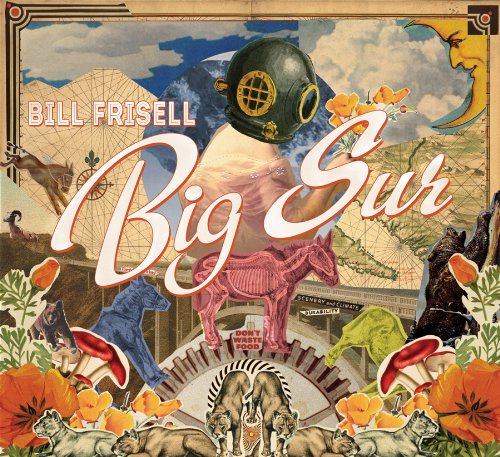
Bill Frisell: Big Sur

At this point in the career of guitarist Bill Frisell, there’s not much point in continuing to talk about his music as “jazz”—or as “Americana” . . . or really as anything for that matter. Frisell has cornered the market on something wholly his own: an instrumental form that uses elements of different genres to create cinematic soundscapes that lope or slither, walk or skitter like a great character making his way across a movie screen.

Big Sur is an outing for the leader’s “858 Quartet”, which is Frisell plus Jenny Scheinman on violin, Eyvind Kang on viola, and Hank Roberts’ cello, plus the drummer Rudy Royston. Frisell wrote this music (19 somewhat connected short tunes) on a commission while staying on a ranch at Big Sur, inspired by classic California coastline. The sound is mostly open and pleasing, and maybe sometimes just a little too nice—a little boring—in the way that beauty sometimes can be.

So, to be sure, this is mostly very “pretty” music, and that may be its glory and its problem. Although there is plenty of folky edge here—a kind of funky sweetness that suggests authenticity—most of the music on Big Sur is consonant, mid-tempo stuff. It’s soulful, like, dig “Highway 1”, with Jenny Sheinman’s violin bending notes and the strings generally playing syncopated patterns over a two-chord groove. Or how about the delightful but lightweight “We All Love Neil Young”, a duet between Frisell and Kang that is a charming minute and a half of skipping guitar and pure melody? Nice stuff.

But very nearly each of these little portraits leans on a certain kind of easy, loping vibe—a dreamy melodicism that comes with all the right kind of “authentic” American/folk affectations. It’s interesting and cool—but I admire this music more than I like it. The tunes feel a bit like museum exhibits. You might say that this music presents you with a bit of a guilt trip: Hey, man, you really should dig this, whether it’s terrific or not, just because it sounds so “real”.

Read the entire review here: Bill Frisell: Big Sur

Wednesday, September 11, 2013

JAZZ TODAY: Later, Marian McPartland

On Tuesday, 20 August 2013, we lost pianist and radio host Marian McPartland. Marian (as everyone called her during her more than four decades in radio) was the best ambassador and educator in jazz history. The music will miss her more than it knows.

Jazz and Radio—a Critical Connection

Radio has been critically important to jazz. All contemporary music, prior to the last ten years or so, has had radio to thank for the way that folks discovered its joys. Jazz, pop, rock ‘n’ roll, soul. For jazz, however, radio was particularly important. During radio’s pre-television heyday, jazz was the star, with Benny Goodman and Duke Ellington among many others surging to public consciousness from dance halls all across the US and into living rooms and parties.

Later, urban jazz DJs promoted and ushered in new jazz styles—most notably bebop, which ascended significantly based on the support of folks like Symphony Sid or Mort Fega. And when jazz became harder to discover in the pop culture landscape of the ‘60s and ‘70s, the word still spread through great jazz stations on public radio in New York, in Chicago, on the West Coast, all over.

Starting in 1964, Pacifica Radio’s WBAI in New York started letting a British jazz pianist from Great Britain—the 46 year-old Marian McPartland—interview guest musicians on the air. In 1978, Marion started the show on National Public Radio that would make her more famous than her own music: Marian McPartland’s Piano Jazz. She kept recording episodes well into 2010, when she was 92 years old.

The effect of this incredible body of work—hundreds of episodes with rare repeat guests—is tough to explain or calculate. But the magic of radio is the thing. When you listened to Piano Jazz, you felt that you were in a room with two real, regular folks—Marian and her guest—who just happened to be talking about one of the most elusive things that exists in the arts: that quicksilver known as jazz improvisation. Because it was radio, you could imagine sitting three feet away from these two folks, maybe sharing the edge of a piano bench with Chick Corea or Ray Charles. You were in on the secrets. It was full-on intimacy.

There was never a radio show that made you feel closer to the divine than this one.

Read the entire column here: Later, Marian McPartland

Wednesday, September 4, 2013

Bassist Stephan Crump, from Pop to Avant-Garde and Back Again

I’ve written before about the singer Jen Chapin, whose style and approach is a perfect example of how “jazz” and “pop” remain in a beautiful dialogue even though Chapin doesn’t sing jazz standards or otherwise hold herself as a “jazz” artist. (“Playing Pop in the Jazz/Soul Shadow”)

Aside from being a fine songwriter and outstanding pop singer, Chapin (the daughter of Harry Chapin, yup) is also married to Stephan Crump, the stylistically catholic jazz bass player. Chapin most commonly performs with Crump—along with guitarists Jamie Fox and Liberty Ellman, which group is otherwise known as Crump’s Rosetta Trio. But Crump is best known as a member of Vijay Iyer’s brilliant jazz trio and for other jazz playing that strays wildly beyond the conventional.

All this is on my mind because Chapin has an irresistible new recording, Reckoning, featuring Crump, Fox, and Ellman as well as a few other folks. It’s yet another example of how smart, contemporary pop can still be soulful and laced with jazz feeling without being “jazz”. And the Rosetta Trio also has a lovely new disc, Thwirl, a stunning essay in chamber jazz that moves from delicate to earthy. And Crump has a new duet recording with guitarist Mary Halvorson called Super Eight that is equally wondrous but that sits at the edge of jazz that is opposite from pop music: fully improvised music without hooks, verse/chorus structure, or anything resembling pop appeal.

All three of these recordings are outstanding. Central to all three is a jazz musician whose refusal to honor boundaries is a badge of honor. Arguably it’s what’s best about today’s jazz musician.

Jen Chapin’s Reckoning

The first sound you hear on the new, terrific, Chapin record is that of Crump’s bass playing a singing groove along with finger snaps and a syncopated drum pattern. The hip rise and fall of the bass melody is a perfect counterpoint to Chapin’s soulful and bluesy verse melody. It’s no surprise, then, that Chapin and Crump have recorded together as just a duet act.

But the appeal of “It’s All Right” goes beyond these two strongest elements. There are Chapin’s words, which provide telling details of difficult life being shared by a couple that is, still, resolved to make it. And it’s all wrapped in a concise arrangement by Crump—a few tastefully deployed strings, sprinkles of percussion, precise interplay between the guitars of Fox and Ellman. The lift of the strings on the chorus isn’t sugary but poignant. It’s wonderful storytelling that works because all the elements work together.

For me, “Let It Show” (a joyful piece of advice for a child, previously recorded by Chapin but not this well) ought to be a hit song—hooky, thrilling, beautiful. And it’s recorded and arranged with perfection: starting with simply strummed acoustic guitar, then layering in bass, guitars, Farfisa organ and Wurlitzer electric piano, even a little touch of glockenspiel. The following song, “Don’t Talk” is equally snappy—a faux reggae song that uses touches of clavinet, a brief little flute line and even a very brief bass “solo” for Crump that appears twice and naturally in the arrangement. That Chapin folds in a sumptuous release that eases of the reggae backbeat and evens out alike a ballad for a half-minute is just gravy.

Not everything on Reckoning is pure pop pleasure, though. “Spare Love (Not Fair)” begins with a duel guitar line that winds in an arcing shape before Chapin joins in counterpoint, all before the band groove sets in. It’s hard not to hear a tune like this as harking back to the kind of complex arrangements that bands like Steely Dan made standard in the ‘70s but that may be out of style in the “indie” atmosphere of the 21st century. But Chapin and Crump aren’t afraid to lay in some harp on this tune. And it works.

The closer on this ambitious record is called “Gospel”, a song that imagines a better world being possible. Again, the arrangement builds from simplicity (an off-center drum and bass groove that allows Chapin to sing a simple blues melody) to great complexity, with a significant harmonized chorus, a piece of spoken-word recitation, Hammond organ and celeste, and then a sensuous trumpet solo from Ambrose Akinmusire on the long out-chorus.

And those are just some of the stand-out tunes on Reckoning—a pop record that means to be, and is, much more than just some catchy licks and some passion. In fact, if you listen without enough attention on the first pass, Chapin’s work might seem “merely” pleasant. But just a little care and attention to the lyrics and arrangements suggests that Crump and Chapin have created a surefire gem: the kind of carefully-crafted and sophisticated pop that used to be associated with Paul Simon. Yeah, it’s that good.

So, a jazz bass player is making brilliant pop records—like Jaco Pastorius used to to with Joni Mitchell. But is his own jazz playing much to hear?

The Rosetta Trio’s Thwirl

It very much is.

The heart of Chapin’s band on Reckoning is actually Crump’s band. Or, rather, one of his bands. Crump’s acoustic bass along with guitarists Jamie Fox and Liberty Ellman make up The Rosetta Trio. As the heart of a group playing a jazzy pop for Chapin, these guys bring elegance and groove to songs that might have been played without soul. In two earlier records, this band has created an identity as an instrumental jazz trio that deserves a wider hearing.

Thwirl is the trio’s new record (out in September), and I think it is their best—impressionistic at times, but also soulful and singing, interlocking like a beautiful puzzle and also playful and witty. Crump play several different roles in this band—groovemaker on a playful 5/4 tune like “He Runs Circles” or a loping slow soul exercise like “Still Stolid”; primarily melodist on something like “Conversate (Talking-Wise)” or arco balladmaster on start of “Ending” or on the hypnotic middle section of “Whiteout”; or free improvising master on “Palimpsestic”, which begins as a pointilistic exploration and builds into a funky set melody that is irresistible.

Crump’s bandmates here are complimentary—almost to a fault but somewhat surprisingly. Ellman is known for his work in Henry Threadgill’s Zooid band and his association with Vijay Iyer, Rudresh Mahanthappa, and Steve Lehman. Fox’s resume sets him up as a much more conventional player—he was lead guitarist for Blood, Seat & Tears and played with Joan Baez, organist Brother Jack McDuff, and Dr. John. But as bandmates, Fox and Ellman weave a brilliant and seamless cloth of chords, melodies, effects, and textures. I don’t find it easy to tell them apart. The title track, for example, is a polyrhythmic workout, with the guitarists plucking in a percussive maze that evolves into a circular melody that trades from one player to the other. It’s a joy to hear the interplay and selflessness as one statement leads to another.

All the tunes but one were written by Crump, and they show a stylistic diversity that is the equal of, say, bassist Dave Holland. In fact, Holland is the player who might be Crump’s artistic predecessor: someone just as home playing melodically, playing in a pop frame, or roaming free with little harmonic structure. Both have a pungent sound, rich in bottom while still capable of rising up to grab the music’s spotlight.

Thwirl is a truly satisfying record because, like so much of Holland’s work, it is catchy and appealing without ever seeming like it has “sold out” to ease or simplicity. That is to say: though it is perfectly “serious” jazz, it isn’t afraid to appeal a listener’s sense of pop pleasure. Which makes sense if you know that Crump is also a key force in Chapin’s sound.

But, it turns out, he can cut loose, wildly loose, too.

Secret Keeper’s Super Eight

Crump’s duet project with guitarist Halvorson is called “Secret Keeper”, which is a wonderfully suggestive title for a collaboration that is intimate, revealing, and cagey all at once.

Read the entirety of the column here: Bassist Stephan Crump, from Pop to Avant-Garde and Back Again

Everything Old Is New Again: Reimagined Jazz Standards

Getting jaded is the natural province of getting old, of thinking you’ve heard and seen it all before, of believing that whatever is created tomorrow by a bunch of kids has little chance of improving on generations of greatness that came before.

But then something comes along that knocks you out and cheers your heart, that sounds utterly new even while it stands on the shoulders of things you love. And, yeah, it was made by young people you’ve never heard of. And the third time you listen to it, it’s better than the first time. And the fifth time it’s better still.

That’s what happened to me when I heard the brilliant, astonishing new collection of reimagined jazz standards by singer Kristin Slipp and pianist Dov Manski.

A Jaded Critic Gets What He Needs: A Thousand Julys

Dov Manski and Kristin Slipp grew up not far from each other in Maine, and they both wound up at the New England Conservatory at the same time. “Even before college, I had heard about Dov—he was a high school jazz prodigy,” she chuckles. “I knew who he was. When we got to college, a couple of us were from Maine and we felt comfortable together. We were friends even before we started playing together.”

Slipp and Manski started exploring a duo approach to playing jazz, finding that “it was really freeing—there was so much space and so many possibilities,” explains Slipp. It’s hard to imagine that a couple of music students were already working on a project that would create the most daring and intelligent set of jazz standards I have heard in at least 20 years.

But that is exactly the case. Manski and Slipp’s new recording, A Thousand Julys is brilliant and fresh, an utterly original expansion of the tradition that reaches beyond jazz by using the jazz repertoire to express individual emotions.

After listening to these 11 standard tunes a dozen times each, savoring both the emotional directness and the abstraction of the playing, both the clarity and the craft in the singing, I searched for contact information for these incredible young musicians and asked them to grant me a joint interview to tell me how they had made this minor masterpiece.

“The standard repertoire has been done a million times, but we both felt there is so much still to be done,” says Slipp, who adds that there is a particular challenge in “standing out from the pack” as a female jazz singer working with the standard repertoire.

But A Thousand Julys stands far out from the pack as the most thrilling record I’ve heard in 2013.

Playing Beyond Clichés

The solution that Manski and Slipp have developed is not a formula, but it’s based around a couple of key ideas. Most clearly, these versions of old warhorses like “Smoke Gets in Your Eyes” and “You Go to My Head” are cliché-free. To my ear, Manski’s accompaniment steers clear of the standard harmonizations and morphs into different styles beyond what we normally think of as “jazz”. His “I Get Along Without You Very Well” has a “hurdy-gurdy” quality, for example, while his “You Go to My Head” combines a Herbie Hancock left-hand bassline with bi-tonal dissonance in the upper register of the right hand.

“On that tune,” Manski explains, “I wanted to outline the basic structure of the chords in the left hand, using sixths and tenths from stride piano, and then go against he harmonic grain with these bitonal intervals with the right hand. That was the idea, but I didn’t write out specific chords or voicings although this was clearly influenced by classical music. Charles Ives has been a big influence on me.”

The instrumental arrangements, then, don’t run away from tradition as much as they pursue Manski’s interests beyond more traditional jazz. “I wasn’t avoiding anything consciously,” says Manski, “but in this duo it is always okay to play the way I play. I never stray purposely from playing, say, a II-V-I harmony—but the guide is just that I’m only going to play what feels true to myself.”

This freedom, of course, comes from hard work. Both Manski and Slipp are true students of the music. “I do research to understand the song and how it has been played before,” explains Manski. “I study how singers have sung it, how orchestras have played it, the history of the song. From doing the research, I gain the confidence to let go and play naturally.”

Kristin agreed. “We have both absorbed very different versions of the song and have let them marinate. We use that as a guide. And then let it go completely. It’s not a big labored process.”

“Of course,” Manski adds “I listen to Kristin and how she sings each song.”

Singing Both Inside and Outside the Jazz Tradition

Slipp’s singing can be deceptively simple when you first hear it. She often starts her renditions of songs in an unadorned manner, not only avoiding unnecessary melodic embellishments but also singing with a tone and timbre that is notably plain or even “spoken”, with limited vibrato and a sensibility that comes from rock or folk singing.

Read the entire column here: Everything Old Is New Again: Reimagined Jazz Standards

Dave Holland: Prism

In the early 1970s, if you were listening to instrumental music played by electric guitar, electric keyboards, and very busy drums, all executing tricky business and intricate patterns that would explode into fireworks of improvising, you were a fusion fan. “Fusion” was a kind of jazz-rock music that blossomed brilliantly for only a few years (Chick Corea’s Return to Forever, Larry Coryell’s Eleventh House, John McLaughlin’s Mahavishnu Orchetra, Tony Williams’ Lifetime, and the band Weather Report, for example) only to quickly flame out. This “plugged in” jazz seemed to come from Miles Davis’ experiments in the late ‘60s and early ‘70s, but it didn’t take long for it to become lame instrumental funk, so-called “smooth jazz”, indulgence in various forms.

But, at its best, it was marvelous.

And acoustic jazz bassist Dave Holland—who played on some of those great Miles records that birthed the stuff but never really had a “fusion band”, per se—has now created the coolest fusion record I’ve heard in decades.

This new quartet is fronted by guitarist Kevin Eubanks, who played with Holland long ago (before his Tonight Show gig) and keyboard wizard Craig Taborn. The drummer, dazzling, is frequent collaborator Eric Harland. It’s a wonderfully balanced group, likely because the leader stays fully back of the pack, serving up great compositions but rarely crowding his players for sonic prominence. The result is a huge smear of sound and joy: exuberance, subtlety (yeah, even in fusion), beauty, fire.

It’s a great record.

Part of what makes Prism sound specifically like “fusion” is the preponderance of tunes that do not “swing” in the usual sense but are instead built on tricky riffs that interlock with a groove that is heavy on backbeat. The opener, Eubanks’ “The Watcher”, begins with a funky line from the left hand of Taborn’s Fender Rhodes electric piano, and then Eubanks doubles it before he climbs on top with a distorted but very simple melody. The sound is thick with fuzz and buzz from both Eubanks and Taborn. All of it would make for a satisfying track, but then a tricky and precise bridge section comes along for pleasing relief. Taborn’s solo is the standout here: mathematical and intriguing as it moves and reverses, surges forward and doubles-back on itself.

This lack of traditional swing flows across tunes in many tempos and styles. “The Color of Iris” is a ballad (also by Eubanks) featuring the guitarist’s mellower tone, but it is set over a bass groove that doubles Dave Holland’s huge low notes with the left hand of the acoustic piano, each note coming as a syncopated surprise, with Eric Harland controlling the flow with his cymbals. Holland’s lovely, minor-key “The Empty Chair” has Harland playing a funky triple-meter groove beneath a dirty pentatonic melody from Eubanks—essentially a soul tune built around a clear movement in the bass line. Taborn’s “The True Meaning of Determination” also doubles acoustic bass and acoustic piano with a series of rising/falling two-note phrases that interlock perfectly with a very unpredictable melody played by unison guitar and right-hand piano.

On all these tunes, the “degree of difficulty” is very high (a fusion trademark), but the execution rises even higher. “Evolution” is chock-a-block with stop-start movement that each player rides across with ease. The guitar and piano solos on “Determination” are pure virtuosity: Eubanks flies with power and fluency and then Taborn takes the opposite tactic, punching in a mad, stilted set of high-low jabs that resolve into a lava rush of rhythms and repetitions. “Spirals” is another Taborn tune built around a complex set of jigsaw pieces: piano parts, bass lines, guitar licks, drum fills. It is all played with nonchalant ease, and then Eubanks and Taborn spin astonishing improvised lines atop it all (And, how great is it to hear Eubanks, Mr. TV Sidekick, playing note-for-note and with daring authority alongside a critical darling like Taborn? They’re both brilliant).

Read the entire PopMatters review here: Dave Holland: Prism

Thursday, March 28, 2013

Mostly Other People Do the Killing: Slippery Rock

Mostly jazz can be tedious. I mean, I love it, but way too many people will tell you, “Yeah, I love jazz! I put it on as I’m going to sleep!” Or people will say, “Jazz is great for studying.” Which means, mostly, that it’s background hum. It’s the soundtrack, mostly, for doing things that require some kind of adult sonic wallpaper.

Mostly, jazz is a hip kind of boredom, right?

But not when it’s played by Mostly Other People Do the Killing. This quartet—Moppa Elliot on bass and primary composer, Peter Evans on trumpet, drummer Kevin Shea, and the suddenly ubiquitous saxophonist Job Irabagon—plays jazz with a sense of adventure and daring, a perspective that refuses to honor too completely the past even as the band’s music usually has roots in what came before.

Which is to say: Mostly Other People Do the Killing is mostly wonderful, mostly compelling, mostly rich in ideas and energy and invention.

The band’s latest is called Slippery Rock! (another reference to a town in Pennsylvania, continuing the “joke” from MOPDtK’s This Is Our Moosic, in which every tune evoked the name of a town in that state). But, as is almost always true with this band, the music itself is no joke. In fact, MOPDtK’s music is no more gag-filled than that of, say, Charles Mingus. This band plays music rooted quite seriously in the jazz tradition, widely considered, from Armstrong’s contrapuntal approach to the manic flights of bebop to the tonal and harmonic abandon of Ornette Coleman or Rahsaan Roland Kirk. Here, as across their discography, the band also incorporates the dramatic expressionism of the contemporary “free” musicians from Chicago or Europe, using techniques of juxtaposition and contrast in composition and improvisation. As a result, the group’s sound and approach always has a sense of surprise and daring.

And in that surprise, sure, there is often a sense of madness or looseness that can seem like humor. Not jokes, exactly, but rather a joyous sense that these jazz musicians are not grim about their art. They are mostly gleeful and celebratory. Most assuredly.

That said, the packaging for MOPDtK records often uses humor. Slippery Rock!” has a cover that suggests a ridiculous ‘80s “new wave” band, with the band members wearing neon-colored suits and leaping across the tacky graphic design in period goofiness. The “liner notes” extend the gag, claiming that all the material here was inspired by Moppa Elliot’s immersion of “smooth jazz” records from the late ‘70s and early ‘80s. Though, the thing is, while this music sounds absolutely nothing like smooth jazz, the more you listen, the more you realize that Elliot may, in fact, have found motifs and elements from that body of work that helped to inform these otherwise knotty and compelling tunes.

Whether this is “funny” or “true” or not may be beside the point. Mostly, you need to listen to the music for the pleasure it gives and not so you have some critical understanding of its origins. And this music is so rich in action and content that it should give any fan of modern jazz a mostly full-on ear-to-ear grin.

Smooth or not (and it’s really not “smooth” at all), there is a ton of rockin’ groove in these tunes. The expressive “Jersey Shore” is rich in tumultuous backbeat, and the melody sounds more like a funky blues tune than any avant-garde jazz. But the way that MOPDtK puts this kind of music across is decidedly different: loose and expressive, with very little “taking turns” for solos and a great deal of collective blowing, with Irabagon and Evans flinging wild notes with abandon. On this tune, however, you can’t help but notice that the seeming madness is coordinated with intelligence and care—creating a spellbinding counterpoint that is capable of suddenly pulling back to a whisper, to a series of longer held tones, or to coordinated jabs or slurs. “Yo, Yeo, Yough” grooves too, with a bass line that is funky and fat, and “Dexter, Wayne and Mobley” evokes three tenor giants in its melody, but not in its hypnotic rhythm feel of bouncing funk bass and syncopated hi-hat clatter.

Read the complete PopMatters review here: Mostly Other People Do the Killing: Slippery Rock

Wynton Marsaliss Blood on the Fields, Still Genius

A few weeks ago I had the experience—full of both promise and tension—of revisiting a piece of art that I once thought truly great. The fear, of course, is that such things cannot live up to your memory and hopes. Is anything ever as wonderful as it seemed when you first fell in love with it?

Ah, but some things are. Some things are sublime. Some things are sweeter over time.

cover artA First Love

Wynton Marsalis’s three-hour jazz oratorio, Blood on the Fields, won the 1997 Pulitzer Prize for music—a first for a jazz composition. I saw it performed around that time at Washington, DC’s Warner Theater, which was after it was debuted at Lincoln Center in 1994. I arrived at the concert with a dozen of my music students and insanely high expectations: I had been listening to the recording (featuring the voices of Cassandra Wilson, Jon Hendricks, and Miles Griffith) for a while, and all three were on hand with the composer and his Lincoln Center Jazz Orchestra. Our breaths were stolen.

Blood on the Fields was classic Marsalis: a work that was serious and wildly ambitious—and potentially a great heap of pretention. Marsalis set out to chronicle American slavery by telling the story of a couple, from their travels to the US over the Middle Passage to a brave defiance of servitude, to brutal punishment and hatred, to a form of transcendence, love, and eventual escape. The music, on the surface, was mainly Ellingtonian, but it also reached for a full history of jazz, from field hollers and blues, to Tin Pan Alley ballads, to the cries and rumbles of more modern, more free jazz. And the lyrics had little choice but to go right at the topic: addressing the physical pain of the slave ships, the dehumanization of slave auctions, the anger of black Americans as the country that was imposed on them, religion, and the absurdity of hope.

When I first heard it performed, I simply hadn’t heard a jazz musician in my lifetime try something at this level of difficulty. I’d heard brilliant solos, edgy combinations of tonality and atonality, strange instrumentations, all sorts of tricky stuff. But Blood on the Fields was trying something even more daring. Marsalis was trying to fly beyond the usual with a combination of tradition and experimentation while also addressing politics, history, and the internal human struggle. I mean, I was embarrassed just to like it, it was so potentially full of itself.

But I loved it. As weighty as it was, Blood on the Fields was melodic and fleet, with a huge array of different grooves. The singers were distinctive and ripe: Wilson’s mahogany contralto, Griffith bringing a desperate, raspy cry (“Yooooou don’t heeeeear no druuuums, womaaaaan!”), and Hendricks utterly himself in his cheek and his scatting even as he took on different characters. In concert, the band brought an amazing combination of gravitas and loose joy to their playing.

As I left the concert hall with the students, there wasn’t a soul among us who hadn’t traveled six thousand miles through the music that night. “My life just changed”, one student told me. Who could disagree? The Pulitzer was hardly enough recognition.

A Second Look

And then I didn’t listen to Blood on the Fields for about 15 years. Why? Perhaps because it is a three-CD box set. Perhaps because listening to just part of it seems silly. Perhaps because Wynton Marsalis’s standing since 1997 had both risen—he is the unquestioned Most Established Man In Jazz, King of Jazz at Lincoln Center, and Composer of Many Crazy-Long Works—and also fallen. If Wynton once seemed like a youngish guy who was trying, audaciously, to bring jazz to the next level, in recent years he has seemed both nicked by time (dropped by a record label, for example) and a little stodgy.

Which isn’t exactly right. He and his band (and the Jazz at Lincoln Center Orchestra) have been playing up a storm, collaborating (with Willie Nelson, with Eric Clapton, but also playing jazz, you bet), and educating. But still, I was getting along just fine without Wynton—and without remembering Blood on the Fields.

But when a weekend in New York coincided with the first performance of the work in more than 15 years, well… I went out of my way to get tickets. If only to find out if I was still in love.

FIND OUT WHAT I THOUGHT OF THE THE CONCERT BY READING THE ENTIRE COLUMN HERE:  Wynton Marsaliss Blood on the Fields, Still Genius